Dawn Reader

Dawn Reader
from Open Door Coffee Co.; Hudson, OH; Oct. 26, 2016

Monday, May 7, 2012

Isn't "Trollope" a Dirty Word?

Last Friday, as I've written, I spoke at WRA at Morning Meeting.  My topic: how many readers (me among them) want to read everything a writer has written.  I mentioned how, in recent years, readers of all ages have charged through The Hunger Games, the Twilight saga, The Hobbit & The Lord of the Rings, and, of course, the Harry Potter books.

I talked about my reluctance to start with Harry Potter when he arrived in 1997 and how I didn't read any of them until 2007 when Hudson staged its "Last Extravaganza" in July, the celebration for the publication of The Deathly Hallows, the final novel, the celebration that brought as many as 14,000 people here, many of them in costume, everyone swarming around to hear rock music, shop in the stores that had given their merchandise a Harry-theme, watch a Quidditch match, and wait in line at the Learned Owl (our local book shop) and its midnight sale.  The newspaper said the Owl sold 2000 books that night.

When Joyce and I drove into town that night (we'd been to a late movie in Solon) and saw the line at the Owl--hundreds of people at 12:30 a.m.--I snapped.  Bought the books.  Read one a day for seven days while Joyce was off at a week-long conference.

Anthony Trollope, 1815-1882
But my focus in the talk was on the related activity of my reading, over a ten-year period, all forty-seven novels of Anthony Trollope, a quest that had begun in the late spring of 1996 when a student in Aurora, Kym Good, gave me a gift certificate for the book store that used to be out at the Aurora Outlets (can't remember the name right now--Book Warehouse?).  Once night, Joyce and I drove over there, and I saw on a display table some paperback copies of Trollope's Barsetshire novels.

I'd never read any Trollope--but I had just finished reading the complete novels of Dickens and was looking for another project.  Little did I know.

I bought six paperbacks but didn't start the first in the series--The Warden--for more than a year.  (Not sure why.)  But once I started it, well, my fate was sealed.  I charged through those first six, then read in greedy gulps the six Palliser novels, then the other titles that were usually available in local bookshops (The Way We Live Now is a great novel).

But then, after about 15 or so, I decided I wanted to read the rest in the order that Trollope wrote them.  That took some doing.  Many are out of print, so I was ordering through ABE and other used-book sites on the web.

It warn't always cheap, either.  But soon I was so obsessed I was choosing Linda Tressel over food.  (Not really--but close.)  I once paid $38.07 for a used paperback of Marion Fay.  And to show you how quickly things have changed: All 47 Trollopes are now on Kindle for a total of $2.99--cheaper than one of my books on Kindle!  Value!

As I told the folks at WRA, I was always reading a Trollope during those years, always had one with me when I traveled--to Europe or to Mickey's Barbershop.  And just a few months after I finished the Harry Potter books, I finished Trollope #47, his unfinished novel The Landleaguers, whose final word--the last word he wrote--was peace.

In my talk I blamed my former Hiram College English professor, Dr. Abe C. Ravitz, for creating in me this obsession to read everything by a writer.  I like blaming others for my own madness.  It's comforting.

Here's what I said in that speech about Trollope's works ... and I will end with those words ...


In all these novels I read of Members of Parliament—and wealthy folks—and landed folks who’ve fallen on hard times—and grumpy old men who don’t want to leave their estates to their no-good sons—and vicious women (mothers even!) who insist on their own way, who, though bounded in nutshells, count themselves queens of infinite space—and fox-hunters and shooters of game birds—and clueless but arrogant Americans—and young men who must learn about the importance of your word, your honor, about how to love—and profoundly moral young women whose values eventually (though not always) educate and snare the right young man, young women whose goodness can remind a flint-headed grouch what the human heart looks like, what, in fact, it is for.


Sunday, May 6, 2012

Kent State, 4 May 1970


In May 1970, Joyce and I had been married just four months.  I was teaching full time at the old Aurora Middle School (102 E. Garfield Road) and was taking graduate courses at KSU at night.  Joyce was a full-time grad student at Kent, working toward her master's in English.  Although both of us were strongly opposed to the Vietnam War, we were not involved in any of the demonstrations.  It was safe for me to oppose the war: after all, I had a teacher's deferment and would soon be 26--the cut-off age for the draft.  I do not recall that attitude with pride--but it was the attitude I had at the time.

We were living in our first apartment (in a four-flat building at 323 College Court), just a couple of blocks west of the campus, and we both routinely walked to our classes--and to the library.  Son Steve was two years in the future.

There had been lots of protesting in the streets in recent days; sirens sang our lullabies each night.  Searchlights were our nightlights.

On the morning of May 4 I drove to school, knowing that Joyce had planned to be up on campus for the day for classes and then some research in the library.

The first news of the shootings I got in the teachers' lounge: Someone came in and said they heard that several National Guardsmen had been shot on the campus.  (That was the first story we heard--soldiers shot, not students.)  But when the actual news came through a bit later, I was alarmed.  Four students ... shot and killed.  Others wounded. 

I tried to call home, but everyone else on earth was trying to call Kent also.  Nothing but a busy signal.  And computers and cell phones lay far in the future.

I went to see my principal, Mike Lenzo, and told him I had to get home to find out if Joyce was all right.  He quickly agreed (I don't remember who took my afternoon classes), and I headed for Kent on Rte. 43.  But when I got to Streetsboro, the Highway Patrol had blocked 43--no access there to any points south (meaning: Kent).  But I was frightened--and I'd grown up in Portage County--so I took some back roads I knew and got to our apartment without any other problems.

And Joyce was there.  The relief I felt I cannot to this day express.

Joyce told me that a student had run in the library while she was there.  They're killing us! he cried.  They're killing us!  His hands were blood-soaked.

We decided we would not stay in town.  Helicopters were hovering overhead; armed soldiers were in the streets of Kent.  We had no idea what the night might bring.  Mike had told me we could stay with them, so we packed a few things and headed for the Lenzos' home in Twin Lakes.  We stayed there a couple of nights.

Our only frightening moment: As we were driving out of town on Depeyster (see map) we were stopped at the Main Street intersection. (Yellow star marks our position.)  To our left--what was then a rooming house; to our right, the parking lot of the Firestone store.  In the Firestone lot was a National Guard Jeep with a heavy machine gun mounted on the back.  Two soldiers.

As we sat there at the red light, a student leaned out of an upper window of the rooming house and yelled, Fuck all you murdering pigs!

We looked at the soldiers, who swiftly swung the machine gun our way.

I ran the red light.

In a few days, back in our home, we walked the streets of Kent and marveled.  All the driveways to the university were blocked by armed Guardsmen.  Downtown, I took a picture of a store window.  It bore a large message: Happy Mother's Day!  But the reflection showed an armored military vehicle passing by.  (I can't find that old photo now--will look more assiduously later.)  Mother's Day was on May 10 that year.

We had to finish our courses by snail-mail.  (No faxes in those days; no email.)

So ... we were not directly involved.  No one shot at us.  We had a very dear friend who was involved that year, though.  Harry Vincent, from Garrettsville (I'd played on baseball teams with him, had been in college with him and his older brother, Jim) had to hit the ground when the bullets flew.

Both Joyce and I, though--and millions of other Americans--were wondering what was happening to the country we grew up in.  JFK, 1963.  MLK, 1968.  RFK, 1968.  KSU, 1970.  Jackson State, 1970.  It was a horrifying time of blood and loss, of dreams shattered by gunfire, while a country lost its moorings and drifted toward madness.

Saturday, May 5, 2012

A Great Teacher's Life

Joyce on Grand Manan Island,
near the summer home of
Willa Cather
I know I said I'd blog today about May 4, 1970--and I will.  Tomorrow.

But today, instead, I want to write a little about what happened yesterday afternoon at Hiram College, where the English Department sponsored a reception for Dr. Joyce Dyer, who will be retiring at the end of the current academic year.

It was a wonderfully eclectic gathering of colleagues, students (current and former), friends, family (son Steve arrived with his wife, Melissa, and our two grandsons, Logan and Carson; Joyce had not known they were coming--a moment of great emotion), and others.

Her colleagues Mary Quade and David Anderson spoke movingly about their experiences with her; several students recalled her transformative (their word) effect on their lives.  And Joyce herself spoke briefly at the end, reading some words from Paul Auster, reciting a memorized passage from Henry James.  It was impossible not to weep.

But I wanted to write just a little today about the Joyce that her colleagues and students never really saw.  The Joyce I saw at home--the teacher preparing to teach.  Oddly, I don't believe I've ever watched Joyce teach a class.  I have certainly heard her, though!  When we were colleagues for two years at Western Reserve Academy (1979-1981), I often heard her as I walked in that lower hall in the "English Wing" of Seymour Hall.  As she became impassioned about what she was talking about (which never took very long), her voice would brighten and soar, gain texture and strength sufficient to carry aloft all those lucky students in her room.  If I hadn't admired her so profoundly, I would have been jealous.

But here's the Joyce at home ...  She is always preparing for class.  Always.  She is reading or writing or thinking.  I know that she carefully re-read, every year, those texts she had used before--not that there were all that many of those.  She frequently changed books, teaching what she was loving at the moment, using the novelty to animate her even more (though she's never suffered, in the decades I've known her, from a lack of animation!).

And grading?  Only those of you who have been her students know the massive effort she puts into her students' work.  I told some people last night--and I was not exaggerating in the slightest--that her comments on a student's paper--on one paper--exceed in word count all the comments I received from all of my college professors, combined, in four years!  She routinely spends an hour, two hours, on one essay.  It's astonishing.  But I know why she does it: She cares as much about her students' writing as she does about her own.  And when you feel that way, what else can you do but be thorough?

She never wastes time, does nothing.  In fact, in that regard, I am the worst influence in her life, for at the end of a long day, I will turn on the TV and watch a bad movie (sometimes, I confess, again and again).  She would never do that and tolerates it in me only because, well, she's Joyce.  She accepts people.  Even a late-night sluggard husband.

Her preparation does not end when the term ends.  When school is in recess, she is not.  She's reading.  Writing. (A writer herself, she knows how her ability to solve her own writing problems can later help her students.)   Traveling to places relevant to her teaching.  I don't believe that we have ever in our forty-two-year marriage taken a "vacation"--a time just lying around doing nothing.  We are always going someplace to see something, to stand on the ground where stood the writers we love--Dickinson, Frost, Cather, Crane (Hart and Stephen!), Chopin, O'Connor, Faulkner, Fitzgerald, and on and on and on.

She has learned one of life's most wonderful lessons--pursuing your intellectual interests is the most exhilarating way to live.  We are never bored.

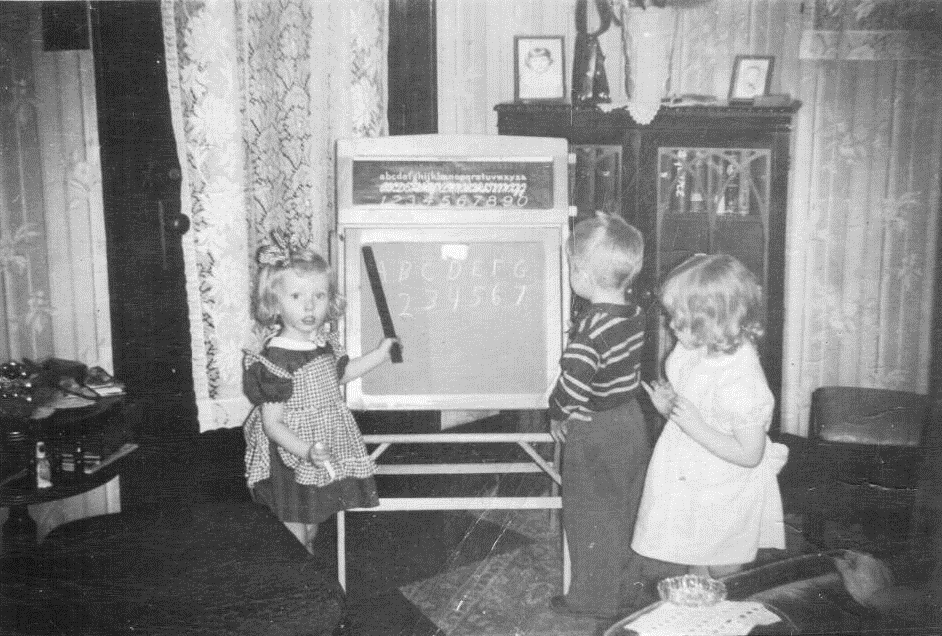
Joyce, age 2 & a half,
practices for her future
And one of her most wonderful assets as a teacher is her ability to create in her classroom--in her students--that same exhilaration.  For words, for ideas, for literature, for writing. Her students know she cares deeply about them and their work.  And so they respond.  And so they have responded since 1969 when she walked into her first classroom and  showed those lucky young people her intricate mind, her capacious heart.

***

Joyce does not know about this blog post--so hurry up and read it, for I have a feeling I'm going to get a "request" about it, very soon!

Friday, May 4, 2012

At that podium again ...

view from the podium (sans students!)
It was a little strange this morning, being back in the Chapel at Western Reserve Academy (I retired from the school a year ago).  The Headmaster had invited me to talk to a Morning Meeting (all-school assembly, about a half-hour), and so I went.  And talked about the obsession some of us share--of reading a writer's complete works.  A lot of the students had read Hunger Games and Twilight and Lord of the Rings and, of course, Harry Potter.

I wove together the stories of my finally yielding to Harry Potter Mania and reading those seven novels and my ten-year journey through the forty-seven novels of Anthony Trollope (I'll write about him another day.)

The Chapel is a historic and historical building.  So many famous folks have spoken there, including Emerson and Frederick Douglass.  (Who most manifestly did not tremble in their graves when they got the word--through a literal grapevine--that I would be talking today.)  I first spoke there in the winter of 1979--about a recent movie, The Exorcist.

And when I returned to the school (fall 2001) after retiring from Aurora Middle School (January 1997), I spoke there many times, usually at the Morning Meetings but sometimes on more formal occasions, too.  Twice I spoke at what used to be called baccalaureate (but is now Senior Celebration).  Usually, what I said was not too weighty.

There were silly poems about Brad Pitt and Angelina Jolie, a dumb piece about what sorts of things people write in the guest book at Panera, parodies of famous poems.  Once--years ago--the students performed a "play" I wrote with some other students; our clever title--WRA and Peace.  (Get it?  Get it?)

Sometimes I talked about writers I liked (poet Edwin Arlington Robinson) or an influential person.  One of the great surprises I pulled on my wife, Joyce, was when she came to hear me a few years ago, never dreaming that she was the topic of the day!  (She took it well--even when I sang (it was near my 64th birthday) the old Beatles' song "When I'm Sixty-Four.")

It was a great opportunity for me--an honor really--having access to that podium--that audience--now and then.  The students and faculty were uniformly welcoming--even today, when fully a fourth of the student body had no idea who I am.  (We gotta listen to another old guy ramble on and on ... it's so freakin hot today!)  And it was (freakin' hot): By the end, perspiration was rolling down my forehead, heading for my moustache and beard (I know: TMI.).  For one of the few times in my life I thought how pleasant it would be to get hit in the face with a snowball.

Thursday, May 3, 2012

A Leopard in Norway


Last night I finished the latest thriller by Norwegian writer Jo Nesbo (another melancholy Nordic?).  I've read all of Nesbo since his first, The Redbreast, and have generally admired and enjoyed him.  Although, to be honest, a hero with the name of "Harry Hole" is a little hard to deal with. I mean, if my name were Harry Hole, I'm pretty sure I'd change it--and then sue my parents.  (Can you imagine poor Harry Hole in middle school?  It was bad enough with my name, which my waggish "friends" easily transformed into Danny Dyer-EE-uh--a name that seems ever more appropriate as I find myself writing logorrheic blog posts every day.)

Harry Hole aside ... I thought The Leopard was too much, even for my capacious indulgence for mysteries/thrillers.  The story leaps across continents (twice, Hole is in Africa, where things get a bit ... hairy), up into the mountains (no-no sex and an avalanche in a skiiers' cabin), and there's a homicidal device our villain employs several times--an insidious metal ball placed in the victim's mouth; do the wrong thing and needles emerge from the ball and you choke/drown in your own blood. 

There's also a Bad Cop (an overly ambitious equivalent to one of our Overly Ambitious Feds), a fallen woman, a lost lover, an ailing father--about all that's lacking is a white whale bearing a scarlet letter and spouting "It was the best of times, it was the worst of times."

Nesbo's got an imagination--no question.  He's got a writer's chops.  And his books sell in Harry Potterian numbers.  But here's hoping he does a little more pruning on his next narrative hedge the next time he looses Harry from his hole to look at life's dark shadows.

**

And don't forget--if you've got a Kindle, I've got some books there for you to read!  Click on link: Dyer's books on Kindle

Wednesday, May 2, 2012

In the Swamp with Karen Russell

Last night I finished Karen Russell's first novel, Swamplandia!--a book that earned wonderful reviews and was a Pulitzer finalist (though, as we know, the Pulitzer judges copped out this year and awarded no fiction prize).

Last spring, when I retired, my English Department colleagues at Western Reserve Academy gave me Russell's first book (yes, a first printing!), a collection of stories, St. Lucy's Home for Girls Raised by Wolves, a book that, well, dazzled me.  Story after story had me muttering, But you can't do that in a story!  But, of course, you can--or, at least, Karen Russell can.  In sentence after sentence she found new ways of saying old things--new ways that made me realize that the old things were, well, not so old.

In one story (even her titles are worth the cover price), "Z. Z.'s Sleep-Away Camp for Disordered Dreamers," the narrator tells us, "This year, we've got a New Kid, this Eastern European lycanthrope.  He is redolent of tubers and Old World damp.  New Kid's face is a pituitary horror, a patchwork of runny sores and sebaceous dips.  Ginger fur sprouts from weird places, his chin, his ears" (55).

I don't know really where to stop quoting: Her writing just rolls on like this, with me bouncing along behind like a happy caboose.

In St. Lucy's we meet some characters and see some places that appear in Swamplandia!  Her novel is a story of a failed Florida wildlife park--a spot where a family entertains ever-smaller crowds with alligator wrestling and other treats.  But a bigger, newer, flashier park has emerged not all that far away.  And weird things start to happen.  An older sister falls in love with a ghost.  A little sister goes off to find the land of the dead.  A brother goes to work for the competition to see if he can raise money to save Swamplandia!

It is a novel, in one way, about a family rediscovering itself.  Early in the novel, the family fractures with death and disappearance and madness.  We lose track of a couple of characters for a long time and focus on a brother and sister who, separately, are trying to figure out the world beyond Swamplandia!

I liked Russell's stories better than the novel--though in the final fifty pages or so I was really swept up in the events as the scattered lives began to reassemble, with the centripital forces of hope and chance and desperation and resignation all playing important roles.

Karen Russell is a talent--a major one. The effusiveness and novelty of her language remind me of early Updike, although she has very different interests and agendas.

And I will read every word she publishes from now on.  The reason?  For the chance that  I'll get to read another sentence like this one: "Incredibly, Mom stayed dead but the sky changed" (Swamplandia! 18).


Tuesday, May 1, 2012

The Kid Reads THE KID ...

When I was working on my memoir about my life as a reader (Turning Pages: A Memoir of Books and Libraries and Loss--available on your trusty Kindle!), I re-read many books from childhood, boyhood, adolescence.  I have a whole chapter in the memoir ("Sports Bookie") about my obsession with sports novels when I was in junior high--and, okay, probably later on, too, though it was an interest I concealed from many others.

In the memoir, I mention one of my favorites--The Kid Comes Back, 1946, by John R. Tunis, who wrote quite a few novels for the genre now called "Young Adult"--or "YA."  But I don't say much about the book--or my experience reading it.

But I do remember.  I read it for the first time--in cloth cover--a volume I plucked from the none-too-copious shelves of the Hiram School Library, arranged up in front of the large upstairs room principally used for study halls.  Later, I somehow acquired a copy of the paperback whose covers, front and back, adorn this blog post.  The copy you see is not the one I owned as a kid--but it's identical.  I found it on ABE, the used-book site that has sucked away so much of my "wealth" in recent decades.

I was thinking about Kid the other day, looked for a vintage copy on ABE, found it, ordered it.  And it came just a few days ago.  A confession: When I unwrapped it, tears visited my eyes, for it's been more than a half-century since I'd seen this cover.

And then the back cover!  I had completely forgotten that it bears illustrations of moments from the book.  I realized, looking, that I could have told you what they were, even before the book came.

I read the 231-page novel in two greedy gulps.  It's generously illustrated with line drawings by George Meyerriecks, a name I could not have come up with under any circumstances whatsoever.    I couldn't find much on him with a quick Google search--but I did come up with an auction notice about one of his pieces, Age of Transportation--see illustration at left!

For some reason, when I was reading the book at Starbucks yesterday, I felt that I ought not let anyone around me see what I was doing (I did the same thing when I read the first Twilight novel in public).  And, of course, two different people came over to visit--and their principal reason?  To look at the freaking book I was reading!  (I'm like that, too, though--I sneak-peek at books other people are reading in public.)  But these were not sneak-peeks; these were flat-out Why-are-you-reading-that visits to "my" couch in Starbucks.

I remembered the story very clearly.  Roy Tucker--slugging Dodgers' hero center fielder of Tunis' The Kid from Tompkinsville, is flying bomber missions in France during WW II.  Their plane has a crash-landing; he hurts his back and leg ... will he ever play again?  (Unsure?  See: title.)  Back home (after being briefly captured by the Nazis, then rescued by the French Resistance), he undergoes some surgeries that don't help, then deals with a doctor who must be a chiropractor (though it's not mentioned).  He gets some treatments, does some exercises, "comes back" with the Dodgers mid-season, leading them to the pennant, an achievement not decided until the final game when Roy rushes headlong into the railing to catch a pop foul (he's playing 3rd--that's another story), crashing into it with abandon, giving all for his team and for ... VICTORY!  (Tunis leads us to believe the damage is slight--certainly nothing to prevent Roy from starring in the World Series to come.)

I was surprised by a few things.  Roy shows a real sympathy for the black soldiers he sees in France, for example--not something you'd expect to read in a boys' book from 1946.  The vocabulary is not simple, either: desultory pops up on one page.  And the writing?  Well ... it's over-the-top sportswriting for YA readers.

An example: That day his fast ball was smoke; his curve was so sharp you could shave with it (189).  Writing!!!!

And another word I'd not seen in a long time--but a word that used to appear in newspaper accounts of baseball games--bingle.  Webster's 3rd has it--a singleThe Random House Dictionary of Historical American Slang traces it back to 1902, but, as I said, I've not seen it--or heard it--in years. (Word's spell-checker doesn't like it, either.)

At the time I was reading books like The Kid Comes Back, the mid-late 1950s, I was certain that I was going to be Roy Tucker.  There was no question about it.  None whatsoever.

Didn't happen.

But for a couple of hours the past couple of days, I found myself sliding (safely!) back into the welcoming arms of boyhood fantasy.  A nice visit.  But I wouldn't wanna live there ...