Dawn Reader

Dawn Reader
from Open Door Coffee Co.; Hudson, OH; Oct. 26, 2016

Tuesday, April 21, 2020

My (Relatively) Placid School Years

Adams Elementary School
Enid, Oklahoma
I began Kindergarten in Enid, Oklahoma, in the fall of 1949 (Mrs. Dugan!) and graduated from Hiram High School (Hiram, Ohio) in June 1962. And, for the most part, I had a fairly placid time.

There were exceptions: harassment by bullies (D. McDonald, I’m talking about you), guilt about not getting my work done (I learned to deal with that guilt quite well, thank you), a broken heart now and then.

Here's the first of those I remember. Back at Adams School (fifth or sixth grade) we learned square dancing. I was decent (no more than that, believe me), but, somehow, I was chosen to be in a group that would perform for parents. So there we were: four girls, four boys. One of those girls, Linda, had a pretty sizable apartment in my heart.

The teacher told the girls to pick their partners (not a bad idea--no fights broke out), but when it came time for Linda's pick (my memory is that she went first), she picked ... the New Kid, a boy whose name I have long suppressed, a boy who'd been in the school only a few weeks.

My heart shattered like a fragile wine glass and clattered to the floor with a sound that must have awakened people in different time zones.

But everyone in that Adams room that day pretended they didn't hear.

Another traumatic event in my elementary years: going to see the many rattlesnakes held in cages at nearby Phillips University (only a block or so away), snakes that had been captured during the state's annual rattlesnake roundup. We marched by the cages, which were very close to us, while the snakes coiled and rattled and leapt toward us, banging their heads into the wire-mesh doors. I think I died a half-dozen times that day.

But the worst thing? We had periodic atomic-bomb drills. We would crouch under our desks, fold our arms over our heads--a certain survival technique--and think about those Soviets that just might attack us here in Enid. Scared the hell out of me.

Later on I became a teacher myself, and for most of my career, all we had were occasional fire drills. Later, we added tornado drills, and seeing the kids coil their arms over their heads reminded me of A-bombs.

By the end of my career, though (June 2011), we were having mass-shooting drills. Locking doors, crouching in classrooms, staying out of sight, remaining silent, waiting for the all-clear. I could tell that a number of the kids were terrified--in a rattlesnake-cage sort of way.

Now, we have grandsons who are in school (one in fifth grade, one in ninth), and they have had to deal with some horrifying things--not just the school-shooting drills but this current COVID-19 situation. Distance learning. Missing their friends and, yes, their teachers.

But other horrors have existed for them, too--and I use the word horrors seriously here. The horrors of continual standardized testing. I've written here before that both our grandsons have taken more standardized tests already than I did, K-Ph.D.

These tests, in my view, have had many deleterious effects: the tension and pressure on young students, the narrowing of the curriculum (teach what's on the test!), the handcuffing of teachers to some rigid (and fairly arbitrary) standards. I think of some of the most wonderful teachers I ever knew (as a student, as a colleague), and I cannot imagine them marching lock-step through a prescribed curriculum. It would be like cutting off the leg of an Olympic gymnast.

Oh, and I should not neglect the rise of social media--and how easy it has become to bully in so many different ways now. When I was in school, bullies knocked the books out of my arms--or punched me in the upper arm--or muttered dire threats as they passed me in the halls.

But now? Bullying spreads online like--like--well, like a virus.

Monday, April 20, 2020

Sourdough Bread

yesterday's loaves
In these days of quarantine, many people are now baking at home. I see the pictures on Facebook; I see the shortages of flour and yeast and other ingredients. In normal times I'm kind of a pack rat, so I've always kept "extra" bags of flour around, but I'm still checking every day for more--and not having much luck.

Anyway, a few FB friends have asked for my sourdough bread recipe, so I've reproduced it below--but, first, some caveats:

  • Although I've been baking bread every week since, oh, about 1971, and even though I've been doing sourdough baking since the summer of 1986 (when I acquired my starter in Skagwa, Alaska), I am not an authority. I do not try a lot of different things. I've found what Joyce and I like, and I pretty much stick to those things--
    • bread and rolls, waffles, pizza, muffins
  • Much of what I do--and what you will likely do--depends on experience. I screwed up a lot when I was first baking (glad I didn't have a camera-phone then!), and I still have occasional (okay, rare) disasters, so all I can tell you is that you need to play around with it--don't be afraid: Sourdough is pretty hardy stuff.
  • Also--don't go by the clock; go by how the dough looks and responds. Temperature and humidity affect rising times. Sometimes it takes 2 hours, sometimes 3. Be patient. It's gonna do what it's gonna do, and all you can do is be patient--as with a child or pet!


Here we go.


  1. Once you've fed your starter and separated it--some for baking, some to return to the fridge for next time--take about 2+ cups of starter (at room temp), put it in your electric mixing bowl, put
    starter ready to separate--and bake
    that on LOW and slowly add the following ingredients:
    1. 1 cup of warm milk
    2. 1/4 cup of melted butter/margarine
    3. 1/4 cup of honey
    4. 2 teaspoons of salt
  2. Slowly add flour to the mixture until it's kind of a thick paste--but not too thick. 
    1. I use multiple kinds of flours (as many as sixteen!), but you want to make sure that you use more of flours that have gluten, less of those that don't. Reason: It's the gluten that allows for a smooth rise.
      1. Some of the flours I use: oat, whole wheat, white, barley, flaxseed meal, graham, spelt, soy, brown rice, quinoa, teff, millet, kamut, raw flaxseeds, etc.
      2. Again--be careful: don't put in too much and make the dough too thick for the beating (!) that will follow
  3. When you have the paste ready, put it on medium-to-low speed and let it go for 7-8 minutes. This activates the gluten and will allow for a good rise.
  4. When those minutes are over, return mixer to LOW and slowly add whole wheat flour (or white) until it's so thick that the dough is adhering almost completely to the beaters.
  5. Here is where I use a dough-hook to complete the dough's transformation into a ball (return to MEDIUM for this). But you can throw it out on a floured board and do the same by hand.
  6. Slowly add dough as the dough-hook rotates until it is cleaning the bowl and forming a fairly solid ball.
  7. Remove it, toss it on a floured board, and knead vigorously, adding more flour as needed so that when you finish, it's not sticky. I knead mine 100 times.
    almost ready to shape
  8. When it's a nice, doughy ball, put it in a greased bowl (I use spray oil to do so), cover it with Saran Wrap--or a damp towel--and set it aside on a rack in a warm place to rise. As I said, it could take 2 hours or 3 to double in size--which is what you want.
  9. When it's doubled in size, toss it back on the floured board and, using a knife or pastry cutter, cut it into the number of loaves you will be making. (This recipe produces enough for a large round loaf and a smaller one.)
  10. Shape the loaves by hand and place them into greased pans (or use parchment paper, which is what I do now)
  11. Cover and set aside on a rack for Rise #2 (about an hour and a half--could be more or less) until it's again doubled in size.
  12. Preheat oven (350--or whatever temp your baking pans call for). Just before the oven is ready, scatter some flour over the tops of the loaves (I use a sifter to do so), then use a very sharp knife to slice the tops.
  13. Pop them in the oven for about 40 min or more (keep an eye on them--the time varies).
  14. When they're done, they will be brown (duh) and will sound hollow when you tap the top.
  15. Remove them, put them on racks to cool, and, later attack them!
I should note that I use a variety of pans--mostly clay these days--sometimes with tops, sometimes not. Follow the instructions that come with those pans for temperature, top-removal, etc.

Again--I play around with things almost every week. I guess I'm just advising you to figure out what you like--and go for it!

Sunday, April 19, 2020

Sunday Sundries, 273


1. HBsOTW [Human Beings of the Week]: Is there any question? This week? Any week? Every week? HEALTH CARE WORKERS.

2, I finished three books this week: one on Kindle, one that's on my nightstand and gets attention every night or so for about ten pages, one that I read during the week.

     - The first was A White Arrest, 1998, by Ken Bruen, whose novels about Jack Taylor I devoured after streaming the TV series about him (called, oddly, Jack Taylor).  (A "white arrest," by the way is cop slang for a great one--an important one.)


This volume is part of a series about London Detective Sergeant Tom Brant, a crude and violent fellow who may, perhaps, be one of the most un-PC of heroes. This book is part of a trilogy (The White Trilogy)--and, yes, I'm going to start the second one tonight. This story is about some brutal murders of the English cricket team by ... ain't tellin'.

Features of Bruen's style: short chapters, lots of space breaks, dark humor, much dialogue, literary allusions (Brant loves Ed McBain novels--I ate them myself quite a few years ago). I would say one of the principal characters in his novels is Mr. Unexpected.

The books ends with a grim surprise--also characteristic of the Taylor novels--but we'll assume the best because Brant returns in the next book, Taming the Alien.

     - The second I finished was Heart and Science (1882), a late novel by Wilkie Collins (1824-89), whose complete novels I've almost ... completed. (He is probably best known for The Woman in White (1860) and The Moonstone (1868).)

This one is very dark (most of the way) and involves a young physician (who is ill himself), Ovid, and a young woman, Carmina, with whom he's fallen in love. (Complication: She is his first cousin--though that was not the problem then that it is now.) They pledge their love, plan to marry--but Carmina's mother (and Ovid's aunt) is horrified, and, believing a foul story about Carmina's mother, refuses to sanction the marriage.

Meanwhile, Ovid has left for Canada to recover his health, and Carmina, stunned by her aunt's behavior, swoons and seems near death.

Another physician in the story, Benjulia, is a heartless man, experimenting cruelly on animals and (as we later learn) on people. He is watching Carmina--not really to heal her but to see how her illness progresses! There's also a creepy piano teacher (who gets his).

The resolution arrives ... Ovid returns ... and Carmina ...? Ain't sayin'.

Anyhow, I love this paragraph about vanity--has some contemporary relevance, wouldn't you say?

The general opinion which ranks vanity among the lighter failings of humanity, commits a serious mistake. Vanity wants nothing but the motive power to develop into absolute wickedness. Vanity can be savagely suspicious and diabolically cruel. What are the two typical names which stand revealed in history as the names of the two vainest men that ever lived? Nero and Robespierre (204 in Broadview Press edition).


I've got only four Collins' novels left!

     - The third is The Egyptologist, 2004, by Arthur Phillips, whose complete novels I've been reading (thank goodness, he's not in the same prolific group as Dickens, Trollope, Collins).

This story--told entirely in letters, journals, and interviews--is about a young man Ralph Trilipush, whose name I learned elsewhere, is an anagram for Arthur Phillips! (Wish I had figured that out; I didn't.)


Trilipush believes that there is a previously unknown Egyptian king, Atum-hadu. And in the early 1920s, as Howard Carter is about to discover the tomb of King Tut, Trilipush raises money from some wealthy investors (one has a daughter whom Trilipush successfully courts). And off he goes in the search.

Oh, and he's also self-published translations of some poems supposedly written by the mysterious king and discovered in the desert. Throughout the book he's continually giving signed copies of the book to other characters (in a sometimes vain hope to impress them).

Trilipush's back story--WW I, Oxford University, his status as a Harvard adjunct--comes into question--as does the entire Atrum-hadu business.

We jump ahead in time, too, to the 1950s when an old private detective, now in a nursing home, is telling the story, via letters,  to another investigator.

Well, Trilipush finds a tomb (or does he)--and inside, lots of ...

This is a powerful novel about obsession, about self-delusion, about how arrogance and outsized ambition can lead to lots of trouble.

I like this: A small scrap of words can yield as many interpretations as there are interpreters (334).
Phillips is astonishing. I've read five of his books now, and each is so different from the others--in subject matter, time period, style, narrative technique. Oh, the research this guy must do!

3. It was a sad moment last night when Joyce and I streamed the final episode of the two-season series The Detectorists, about some English metal-detecting folks. Gentle and wise and moving and funny and sad and ... you-name-it. It's available on Amazon Prime. Thanks to friend Chris for pointing us toward this one.


4. But we've started the new season (6) of Bosch on Amazon Prime (based on the LA detective created by Michael Connelly, who produces here). One difficulty: trying to remember what happened last season!


5. We finished the latest Netflix comedy special by Chris D'Elia, who has an incredibly expressive face and body. Definitely not PG-13 (or PC), but we both laugh a lot when watching him. It's his 3rd special, I think.


6. I've been able to get back on our exercise bike. My dizziness--so constant now--allows it, and I handle it better than walking.

I haven't worked out at all really in the past month or so, except some mile-walks with Joyce during the quarantine, but I'm riding 10 minutes now (burning about 100 cal) and will slowly increase the time as my breathing and leg strength allow.


7. Final Word: A word I liked this week from one of my online word-of-the-day providers:

     - from The Oxford English Dictionary

Henriad, n. With the and capital initial, as the Henriad: Shakespeare's four historical plays, Richard II , Henry IV, Pt. 1 , Henry IV, Pt. 2 , and Henry V , considered as a group or performed as a cycle.
Origin: From a proper name, combined with an English element. Etymons: proper name Henry, -ad suffix1.
Etymology: <  Henry, the name of two Lancastrian kings of England who ruled between 1399 and 1422 (as Henry IV and Henry V) + -ad suffix.
 
1935 Observer  31 Mar. 17/3 It was a good idea to supplement the first part of the ‘Henriad’, now on view at His Majesty's, with its even greater sequel.
1944  J. Gielgud Let.  14 Aug. in Life in Lett.(2004) 76 I wanted to do the Henriad—Richard II-Henry V—at the beginning of this year.
1975 Criticism  17 195 Throughout the Henriad such concepts as ‘legitimacy’, ‘divine right’, and ‘divine justice’ are evoked and examined.
2004  A. F. Kinney Shakespeare's Webs  iv. 109 The Henriad is, finally, a tribute to Henry V's ability…to restore firm rule. 


Saturday, April 18, 2020

The Snow Is Melting ... Again

Here in Hudson, Ohio, yesterday's snow is disappearing fairly quickly--nothing like above-freezing temperatures and some sunlight to speed the process.

We've had snow here the past couple of days, but, like most snow-in-April, it won't last very long. It's almost as if it somehow knows it should not even be here--like an ex-boyfriend who shows
 up at his ex's wedding. Stays a little bit. Departs.

Yesterday, though, it was depressing. Not only are we house-bound (and you know why), but the skies were dark all day, and clumps of snow were perched atop our new magnolia blossoms like whipped cream on a fancy pink drink.

from our bedroom window
But as I look outside right now (about 8:45 a.m.), see that the whipped cream on that pink-magnolia drink has disappeared, consumed by Old Sol, and I can almost see the snow melting in the yard, on the sidewalk.

Ah, the wee pleasures of quarantine!

Because of the gloom and the cold and the snow yesterday, I was not in exactly the most sanguine of moods. (More of a sanguinary mood!) I had to force myself to get up at my wonted time (6 a.m. these day), force myself to clean up, dress, do my chores (unload the dishwasher, etc.), and settle in for my morning's work, which yesterday included finishing a book I'm reviewing for Kirkus Reviews, then writing and filing the review online.

This was an odd one for me--not the book. I review general nonfiction for Kirkus (history, memoir, etc.) and have been doing so for twenty-one years. But yesterday I finished my first book in .pdf form, a text I read on my iPad. Apparently, the magazine is going to be doing this from now on--no more ARC editions (Advanced Reading Copies), pre-publication paperbacks that I've been reviewing since I began in March 1999.

And I actually liked it. Two principal reasons: (1) I could enlarge the text, and the first time I did so, my aging eyes sighed in unison in gratitude; (2) later, when I was writing the review on my laptop in my study, I could quickly check quotations and spellings by doing a simple search in the Adobe Acrobat program.

So ... all of that improved my mood--even though the snow was continuing, the sun was hiding.

Later, in the afternoon, I began reading Ian McEwan's 1998 novel, Amsterdam, and, as usual, he limed me on the first page.

(Okay, limed? I love that word--learned it from the Bard. It derives from the old practice of catching birds to eat by putting a lime mixture on branches they like; the substance catches them--they cannot fly. So ... if you're limed, it means you're caught. Here's an example from Much Ado About Nothing. Some of the characters have planned to trick both Benedick and Beatrice, who love each other but won't admit it--not even to themselves--and as the conspiracy is in progress,  Ursula, one of the servants, says: She's limed, I warrant you: we have caught her, madam. (3.1)).

But it's hard to feel too sorry for myself for too long--even on a mid-April snowy, gloomy day while under quarantine: We have food, shelter, services, safety.

Each other.

Friday, April 17, 2020

And How Remembered?


Yesterday, I read the news accounts of the death of actor Brian Dennehy, 81. (Link to New York Times story.) Several of the headlines mentioned him as the “star” of Tommy Boy, that wild 1995 comedy starring SNL pals Chris Farley (RIP) and David Spade. This was the headline on Yahoo News: Brian Dennehy, "Tommy Boy" Star, Dies at 81.*

He was hardly the star, was he? It’s his death near the beginning of the film that propels his son (Farley) into his position as an on-the-road salesman (with Spade) to secure contracts for the late father’s auto-parts business. Some crazy stuff happens—as you may recall.


I’m sure, of course, that those headline-writers wanted to remind readers who Dennehy was, but I bet he would laugh if he could hear how important Tommy Boy became in his career!

I do remember that film (and, confession: I’ve seen it more than once), and I remember him in some others like First Blood and Cocoon. And as I look at his complete film list in IMDB, I realize a couple of things: He did a lot of films; I saw a lot of them.

But what I remember most clearly about him? His stage performances. Joyce and I used to attend the Stratford (Ontario) Theatre Festival every year—from, oh about 2002-2017. We saw eleven plays in six days, and, several times—several memorable times—we saw Dennehy.

And he was something to see, live.

We saw him as Sir Toby Belch in Shakespeare’s Twelfth Night, a production that updated the setting, not the language. (He was a guy who loved golf.)

We also saw him in a one-man production: Krapp’s Last Tape, a one-act play, by Samuel Beckett. The play is about a man with a reel-to-reel tape recorder, and at one point on the day we saw it, the recorder stopped working. Dennehy paused, stood and walked off the stage. A bit later, a crew member brought out a different one, and on they went, as if nothing had happened.

The last time we saw him was in a great production of Waiting for Godot, also by Samuel Beckett. There was a Q&A after the production, and there he was, in make-up, obviously weary, but answering questions with intelligence and aplomb.

We had seen him one other time, too—exiting another Stratford performance with us. We’d noticed him in the audience—it was an arena theater venue, and he was directly across the acting area from us. Couldn’t take our eyes off of him. Watched him more than the play.

And it was quite by accident that we ended up right behind him in the exit flow. It was all I could do to stop myself from tapping him on the shoulder, telling him how much his performances had meant to me. Didn’t do it—wish I had. (And I cannot even remember what we were supposed to be watching that day!)

Dennehy’s death headlines made me pause a bit. We can’t really know what we’re going to be remembered for, can we? Will it be the great things we did? Or the mistakes? The right moves we made? Or the wrong ones? The people we loved? The people we hurt?

I guess I’m glad I don’t know. I realize all too clearly the good, the bad, the ugly of my life.


*You'll note that the Times headline is more ... generous.

Thursday, April 16, 2020

Ahab Limps On

from New Yorker, 13 April 2020

Some of my Facebook friends have no doubt noticed that I periodically share a cartoon that employs the images of Captain Ahab and/or Moby-Dick. (I shared one today--see pic at the top of this post.) The captain and his white whale continue to endure in the comics--if not necessarily on the book shelves.

As I kid I read Moby-Dick in its Classics Illustrated comic-book format. I read it lots of times then--an exciting story of a crazy guy chasing a white whale--and losing all in the process.


Later, in high school, I had a bizarre schedule one year: four consecutive study halls in the afternoon. I really had no excuse for not having my homework done, did I? Sure I did: sloth.

Up in front of the Hiram High School study hall was the little school library, and I would often go up there, browse through, oh National Geographic (hmmmm, wonder why?), The Saturday Evening Post (loved the cartoons), and other magazines.

Or I'd check out a book to read--usually something about cowboys or baseball players.

But then that John Huston film of Moby-Dick came out in June 1956 (I had just finished sixth grade, and we were moving from Enid, Oklahoma, to Hiram, Ohio, where my dad would teach at the college). That film arrived in Hiram (where the college sponsored Sunday night movies) on November 11, 1956 (my 12th birthday!); I saw it and loved all the action. Oh, Gregory Peck as Ahab! Link to some video. And, checking IMDB, I see that Orson Welles was in it, as well--I'd totally forgotten that.


So perhaps that memory, still percolating in my head a few years later, sent me over to the M's in the Hiram High library, where I pulled from the shelf Moby-Dick and took it back to my desk, which, appropriately, was, like all the others, bolted to the floor.

And I read it.

Sort of. I'm certain that at age 15 (or so) there were vast portions of it I could not have comprehended; there were numerous words whose meanings I didn't know (and couldn't infer) and so ... skipped.

But--with those, uh, exceptions--I read it. My parents, I'm sure, were stunned.

I've read it quite a few times since: college, grad school, later on for pleasure and/or edification.

When I was teaching at Western Reserve Academy the final decade of my career (2001-11), I taught Melville's story "Benito Cereno" (about a revolt aboard a slave ship), so I read a lot by and about Melville during those years. I read all of his other works (even that endless poem Clarel) and every major biography of him (and some minor ones, too). And some modern versions, too--like Sena Jeter Naslund's Ahab's Wife: Or, The Stargazer (1999).

Anyhow, there's something about that story that has engaged the American imagination. Even though many people have probably not read it, the images of Ahab, of the white whale, are so firmly entrenched in our cultural memory that we can look at a cartoon about the book--and there are many--and smile.

First printings of the book (1851) remain real collectors’ items. Dedicated to Melville's friend Nathaniel Hawthorne, the book did not sell well. (That's generous: It sold poorly.) In fact, Melville's career began its nose-dive about then. By the time he died in 1891 (he'd been working as a customs inspector in NYC), he was pretty much gone from the prominence he'd earned with his earlier works--like Typee (1846). Many apparently thought he'd died years before.

So, if you're thinking of picking up a first printing to give, say, to your former English teacher, be prepared: I just checked, and a good one is going for about $84,000 on abebooks.com.

the $84,000 copy

So maybe we should end with a little more humor--yet another Moby-Dick cartoon, this one from August 2014.


Wednesday, April 15, 2020

Stop All the Clocks

W. H. Auden, 1907-73

I stole the title of this post from W. H. Auden (whose poetry I've come to love more and more as I've grown ... older). It's from his poem "Funeral Blues,"* and here's the part I stole: "Stop all the clocks, cut off the telephone ...." Link to entire poem.

Although most of that poem has nothing to do with this post, this particular line does. Let me explain ...

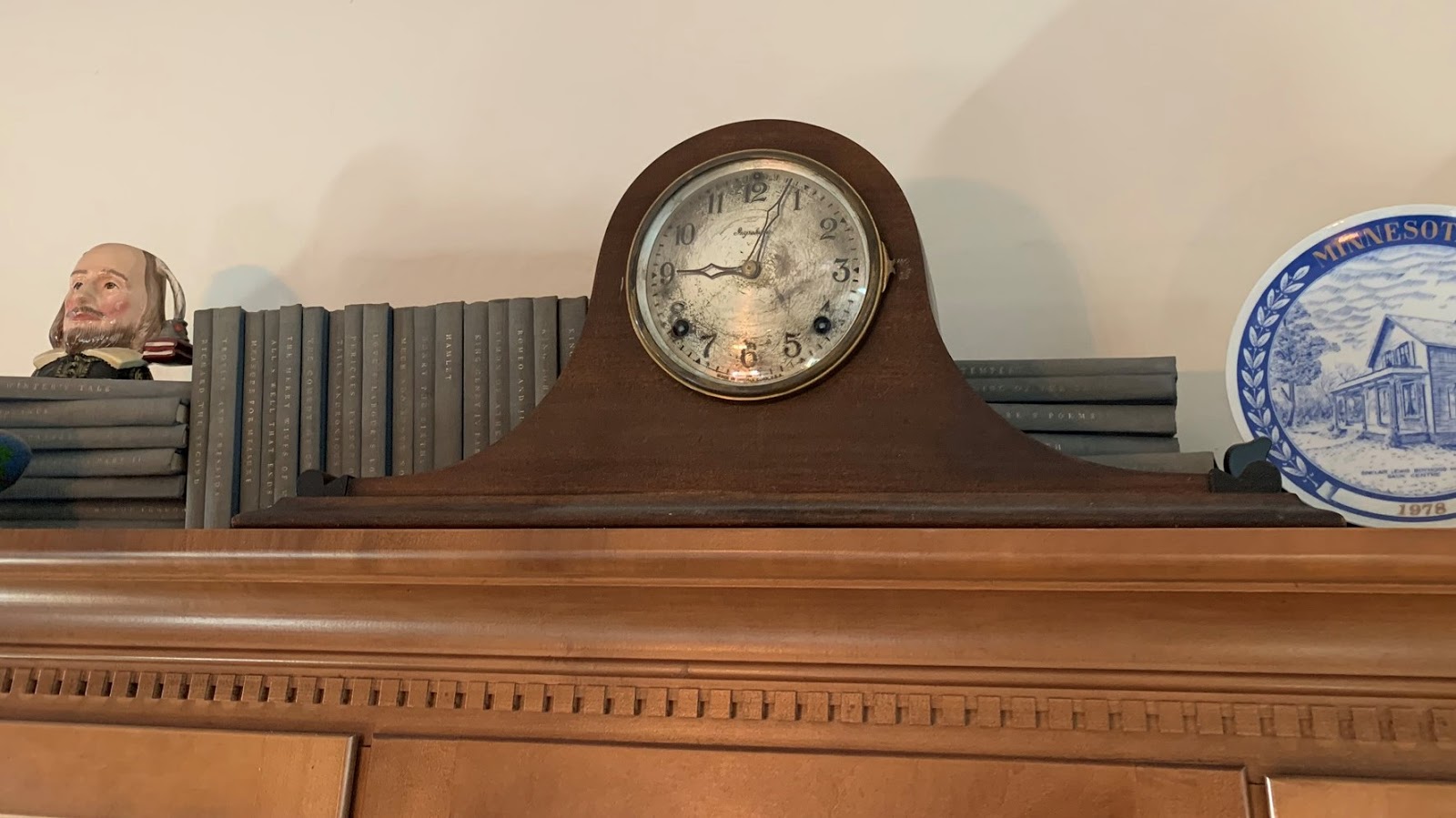
In our house we have three antique clocks--i.e., they have to be wound regularly (or, as in the case of our cuckoo clock, have chains pulled). The oldest and most precious is the cuckoo clock that belonged to my great-grandfather Warren A. Lanterman, who lived on a farm in Austintown, Ohio, for more than 90 years. When he died on March 30, 1963, that clock moved to my parents' wall in Hiram, Ohio, then traveled with them out to Des Moines, Iowa, in 1966 when they continued their teaching careers at Drake University.


When they retired and moved to Oregon in the late 1970s, it became ours and has hung on our wall ever since--in Kent, Ohio; in Lake Forest, Illinois; in Hudson, Ohio (three different places); in Aurora, Ohio.

We've had to have it repaired a few times, but it's generally been a steady, ticking companion for more than forty years.

Until this week.  It stopped. Usually this means it's gotten a little out of alignment on the wall, needs to be adjusted until the ticking is strong and clear and regular.

Not this time.

The two other antique clocks we bought in Lake Forest, Illinois, during our year's sojourn there (1978-79) when both of us were teaching at Lake Forest College, and I was discovering I didn't want to be a college professor. (A discovery I made very soon, BTW.)

Both are mantel clocks. One is a more traditional shape, the other more upright.


the quitter

The latter quit this week.

Again, I tried adjusting its position (usually works--didn't this time).

The single remaining functional wind-up clock is still ticking away, but throughout much of the house there is a silence I don't like. (Joyce doesn't like it, either.)

For more than forty years, you see, the ticking of those clocks has been the heartbeat of our house.

And it's also hard not to see ... symbolism! ... in all this. (Two English teachers in the same house? Of course we're going to see symbols everywhere!)

Lots of people, you see, have been posting a similar message on Facebook: Under the virus lock-down they're losing track of time. They don't know what day it is, etc.

So maybe our clocks, fed up with the disrespect on the Internet, have shut down and will--magically--begin ticking again once the lock-down lifts.

If they don't, though, I have a good "clock guy" to call.

But, oh, do I miss those steady sounds, day and night and night and day and night ...


*I've posted this before ... but I became aware of this poem when I saw the film Four Weddings and a Funeral in 1994. Loved the poem. Memorized it. And here's a link I've posted other times, showing the scene in the film when one of the characters, Matthew (played by John Hannah), recites it at the funeral of his lover. Very moving.

Link to the scene.