Dawn Reader

Dawn Reader
from Open Door Coffee Co.; Hudson, OH; Oct. 26, 2016

Thursday, July 16, 2020

A Memory with Our Son

father and son atop Midnight Dome near
Dawson City, Yukon Territory, summer 1986

In the school year 1985-86 I taught English to our son, Steve, in eighth grade at Harmon (Middle) School in Aurora, Ohio. It was awkward for a few days, but we both got over very quickly the novelty of it.

For a number of years I had been teaching my eighth graders The Call of the Wild at the end of the year (it was in our literature anthology), and I was already in the grip of a Klondike/Jack London obsession that would not diminish until, oh, the late 1990s when I published some books about London and Wild.

We had also recently learned, via my father, that his grandfather Addison Clark Dyer had gone on that very gold rush that London deals with in Wild. I like to think that they met in a bar--had a few--though A. C. Dyer did not mention it in his diary of his journey (a diary that I have).


That summer of 1986 I decided Steve and I would go to Alaska, then into the Canadian Yukon and see what we could see. I'd never been there before. (Joyce, by the way, could not go for various reasons.)

We first drove to Toledo, Ohio (flights were cheaper from there), then to Seattle, where we spent the night with my dear college friends Claude and Dorothy Steele; he was teaching at the University of Washington. We had a wonderful time with them--then flew the next day from Seattle to Juneau, where we waited for a little plane to fly us to Skagway, Alaska, one of the launch points for the tens of thousands of gold-rushers who arrived between 1896-99 (one of whom was Jack London).

Our pilot seemed about as old as Steve (14), but it was a beautiful day, and we landed on Skagway's little airstrip (from the air it looked like a sidewalk!), where some bald eagles were sitting nearby.


We went to the little rental car place (Avis? I think so), where they had two red cars waiting for us. One started; the other didn't. So we decided to take the one that did start.


We had some fun looking around the waterfront, walking around the old town.And after spending a night in Skagway's wonderful Golden North Hotel we drove up into the mountains to begin our 440-mile drive to Dawson City, Yukon, the center of the gold rush.


We crossed the border into Canada, which was protected only by a sign. (Times have changed!)


We had decided not to drive the whole thing in one day--a good idea, for the road was not all that great, and the scenery was wonderful. So we spent a night in Whitehorse, once the scene of the Whitehorse Rapids (now tamed by a nearby dam), rapids that figure in Wild, rapids that London himself had shot on his trip to the Klondike. Steve and I took a boat ride through what was left of the nearby Miles Canyon rapids--whoopee! And that night at a local cinema we saw that masterpiece Howard the Duck.


Next morning it was off to Dawson City, and we arrived safely to our little hotel, and we spent a couple of days wandering around, looking at things London mentioned in the book, locating my great-grandfather's claim (still being worked, by the way) on Bonanza Creek (it had been Rabbit Creek before the Rush!). Warning signs were all around (KEEP OUT! and the like)—so we took a couple of quick photos and then Kept Out.


The picture at the top of this post shows Steve and me atop nearby Midnight Dome--Dawson City below us (its population during the Rush reached 30,000!), the Yukon River flowing toward the west, and the little Klondike flowing into it.

Back in Skagway, we did some more exploring (I bought some sourdough starter which I'm still using every week).


We also drove over to nearby Dyea [die-EE], Alaska, a town that had flourished in the Gold Rush (it's where the dog Buck comes ashore in Wild) but is long gone.


I got a picture of Steve at the head of the Chilkoot Trail (now maintained by the National Park Service and Parks Canada), the trail that figures so prominently in Wild, a trail I returned (alone) to hike over in 1993. (I made it!)


Then it was back home with more wonderful memories than a human head can hold.

Steve was always a great youngster to travel with--from the time he was an infant, really. And I still look back on our Yukon adventure together with a bursting heart.

Happy Birthday to Steve, who today turns 48; I was 41 that day we posed atop Midnight Dome.

Wednesday, July 15, 2020

New Expectations for Teachers?

my 1st teaching contract, May 1966
When I was a schoolboy in the later 1940s and early 1950s in Enid, Oklahoma, and Amarillo, Texas, we had occasional atom-bomb drills. There would be an announcement over the P.A. system (bombers sighted!), and we would crouch under our desks, arms over our heads, and I don't recall feeling anything but this: Now I'm safe!

Enid and Amarillo were both suspected targets, probably because both were homes to Air Force Bases (which is why we were living there: Dad remained in the Air Force Reserves after World War II).

I think we had fire drills, too--though I don't specifically remember them, just the vaguest memory of being lined up (on brutally hot Southwest afternoons) waiting for the "all-clear" signal.

No tornado drills that I recall even though we were in a region where they were common. School officials probably figured: If a tornado comes, nuttin' we can do about it.

On May 18, 1966, when I signed my first teaching contract in what were then called The Aurora (Ohio) Local Schools, it was all pretty vague, the terms. My salary would be $5100 (paid in semi-monthly installments). And I was expected, says the contract, "to carry out the educational programs," "attend meetings," and participate in the Ohio Teachers' Reading Circle, which I never heard of again after the day I signed that document.

That's it.

Through most of my career we had only fire drills--then, later, tornado drills (perhaps because of what had happened in nearby Newton Falls--a twister destroyed so much there in 1985). When I retired from the Aurora Schools in January 1997, we had experienced no "active shooter" drills.

But we had them at Western Reserve Academy here in Hudson, where I taught from 2001-2011. They were frightening, I have to say. Lock the classroom, get out of sight (the doors had windows in them), be silent, wait for the all-clear. I could tell the students were trying to display insouciance--as I was--but I'm betting they were as nervous--or more so--than I: They had grown up in the era of kids shooting up schools all over the place. In fact, one incident was not all that far from Hudson--Chardon High School--a little over thirty miles away, occurring in February 2012, the year after I retired from WRA.

And at last we get to the point of all of this: In recent years, some states and school districts have granted permission for teachers to be armed; armed guards are in some schools, too. A different level for fear.

And in recent weeks there has been a lot of talk about re-opening schools as COVID-19 continues to spread, infect, kill.

And the implication of all this?  My simple teaching contract from 1966 would now have to be amended--updated--and say something like this: You will be willing to give up your life for your students in the event of an active shooter in the building--or in the event of a deadly pandemic.

That's quite an expectation, isn't it?

Would you sign such a contract?

Tuesday, July 14, 2020

Joyce Carol Oates--A Marvel


It's possible I've written here before about Joyce Carol Oates. Tough. I'm going to do it again--for she has been one of the true literary marvels of my reading life--indeed, in all of American literary history, I think.

The first book of hers I read was them, 1969, a novel that won the National Book Award for Fiction in 1970. (And, yes, the title is not capitalized--see pic below.) (She's since gone on to win so many prizes--though not the Pulitzer, not the Nobel--though she's been nominated five times for the former.)


Anyway, them hooked me, and I have read most (not all! who could possibly have read all!) of her scores of novels, her collections of short stories and essays, the novels she wrote under a pseudonym (as Rosamand Smith and Lauren Kelly). She has published volumes of poetry, of fiction for YA readers, books for children, memoirs. A long-time fan of pugilism, she even has a book about boxing--On Boxing (1987--and, yes, I read it). Oh, and some plays, too.

Dickens and Trollope and Collins must be looking down on her (or up?), dazzled from beyond the grave by her productivity.

We don't own all of Oates' books--but a lot, as this picture shows ... and this picture is not a current one!


What can she not do?

The novels are quite different from one another--she is not one of those writers who write the same book fifty times. Style, subject, point-of-view, setting, tone--these vary throughout her work, although she is fond of Niagara County, New York, where she grew up.

She can be violent (or not), nostalgic (or not), horrifying (or not). She can, it seems, be any damn thing she wants to be on the page. A rare gift.

I'm writing this today because I read that she's recently released another novel, Night. Sleep. Death. The Stars. (Sounds like a Stephen King title, doesn't it?) I ordered it, and it arrived yesterday--all eight hundred pages of it! That's right: eight hundred pages!


Another reason she's been on my mind: There's a recent assessment of her in a New Yorker (link to article), an assessment that (sort of) reviews her career (how could a writer possibly cover all of it!?), and although it was generally positive, I felt it was not ... celebratory enough. (My bias.)

Anyway, as soon as I finish the new Colum McCann novel I'm reading (Apeirogon, 2020--maybe tomorrow?), I'm going to dive once again into the magical depths of an Oates novel.

In mid-June Oates had her 82nd birthday. I'm 75 now; maybe I'll finish her new one by the time I'm 82?

Some years ago--in a review of one of her books for the Cleveland Plain Dealer--I wrote that Oates deserves the Nobel Prize. I meant it then; I mean it even more now. Don't want to start anything, but awarding the Nobel Prize in Literature to Bob Dylan before Oates is, in my mind, a travesty. And I've loved Dylan's music since the days of his playing a harmonica and acoustic guitar!

Monday, July 13, 2020

Sunday Sundries, 285


1. HBOTW: For our Human Beings of the Week let's celebrate today the kindness of strangers (that's right: I stole that from Tennessee Williams)--those drivers who let others out into traffic, who stop at crosswalks, who wait till it's safe to make turns out onto the main road, who remember what a turn signal is for, who never tailgate, who pass only when it's safe, who ... you know!

2. We've given up on a few shows we've been streaming--three of them, in fact. All started out well; then we just lost interest: via Acorn: Blood and Dead Still; via Amazon Prime: The Marvelous Mrs. Maisel.
  • We watched most of the two seasons of Blood (about a, uh, troubled Irish family), and the other night we realized we didn't really care about any of these people. (Buh-bye.)
  • Dead Still is in its first season (about a 19th-century photographer who specializes in photographs of the newly deceased); we thought the first episode was really clever. And then ... downhill ever since. (Buh-bye.)
  • We're in the 3rd season of Mrs. Maisel and have tired of it all--the snarling between her parents, their snarling at her, etc. (Buh-bye.) Tremendous production values in that series, though--costumes, scenery, choreography, etc.
We're still enjoying Black Adder (a little bit at a time, mind you), and we're determined to finish all nine seasons of Waking the Dead--though it's taking a major effort. We're also still hanging in there with Perry Mason on HBO (though we're having to be very patient).

3. In our departure from these shows we've been left with a question: Now what? And the other night, just for the heck of it, we started streaming Kenneth Branagh's 1993 film of Much Ado About Nothing (which is one of my favorite Shakespeare films).

When we first saw that film (1993), I was so smitten by it that I immediately replaced The Taming of the Shrew (Burton & Taylor) with Much Ado with my eighth graders every winter. Most of them loved it, too. Branagh, Emma Thompson, John Wick--uh, Keanu Reeves, Michael Keaton, Denzel Washington, Robert Sean Leonard (a heartthrob back then--what's happened to him?), plus a number of wonderful character actors: Richard Briers, Brian Blessed, Phylida Law (Emma Thompson's mother), Gerald Horon, Imelda Staunton). Music by Patrick Doyle.

I showed that film to my classes (five of them!) every year the last few years of my middle-school career--never tired of it. Kids seemed to like/love/tolerate it, too (we had read the play aloud in class). I always wept in class--and wept last night (we watched about 1/2 hour). Emma Thompson is fabulous.

4. We're also streaming the most recent season of Luther (took us a while to get started!), and it's one of those shows that require I don't stream too much each night (I can't take too much tension these days--there's enough of it in the Real World, you know?). Idris Elba. Fantastic.


5. I finished three books this week ...

     - The first, via recommendation by Joyce, was Wesley the Owl: The Remarkable Love Story of an Owl and His Girl (2008) by Stacey O'Brien.


For nineteen years, Wesley (a barn owl) lived in the house with O'Brien, where she, a scientist, studied and loved the creature. And she does not really romanticize the bird (not all that much anyhow). We learn some amazing things about it--its astonishing power of hearing (it can hear the heartbeat of a mouse under the snow--and only mice appear on the barn owl's menu); Wesley figured after a while that O'Brien was his mate, so, some "activities" were performed on her arm now and then; he loved winging around the room, the house; they mate for life--and when their mate dies, they shut down and die as well. So much more in this wonderfully informative book!

     - The second I finished was the first novel by Maggie O'Farrell, After You'd Gone (2000). I'd recently read (and loved) her most recent book, Hamnet, 2000, so I thought I'd try her earlier novels. Good idea!

This is a multi-generational story (O'Farrell cuts back and forth from Grandmother to Mother to our principal, Alice, who appears to attempt suicide in the early pages). So we travel through the pages (and the decades), learning about this family, wondering why Alice would do such a thing (we do not find out until near the very end), reading about love and failure and success and heartache and sibling relationships.

Have to say I loved it. So complex and gripping for a first novel--she was in her 20s! (She was born in 1972--the same year as our son.) How on earth did she do this?!?!?!

     - Finally, I'm reading my way through the novels of Alice Adams (1926-99), known principally for her short stories (she was often in the New Yorker). And last week I read her second novel, Families & Survivors, 1974, a novel that deals with many of Adams' common themes and tropes.


It's the story of two young women, Louisa and Kate, whom we first meet in 1941 when they are fourteen years old, having a naked swim. We follow them, back and forth (though we spend more time with Louisa, the more troubled of the two). The novel ends on New Year's Eve, 1970-71, and in the pages that exist between those mileposts (yearposts?) we learn about Louisa's difficulties in love, her involvement with a married man (who--surprise!?!--lies to her persistently about his determination to divorce his wife and marry Louisa).

The action is mostly in San Francisco (where Adams herself lived for quite a while). No real surprises thematically (I've read Adams' collected short stories, and all of the issues here seem very familiar), but Adams can surprise, as well--stylistically, especially.

The novel is fairly naughty for its era: explicit sex, frank language, an interracial sexual relationship--common enough in fiction in our day. Generally uncommon then.

6. On a personal note: I'm waiting to hear if I'm going to get some financial help on the very expensive med that's next in my metastatic cancer treatment: Xtandi (link to info on the drug). Like the other treatments I've had (meds, radiation, surgery, immunotherapy) this one will be just a delaying tactic. I'm incurable. And I'm worried this time about side effects: Some are downright odious, and I fear yet another decline in the quality of life. Crossed fingers.

7. Last word--a word I liked this week from one of my online word-of-the-day providers:

     - from dictionary.com

rhathymia [ruh-thahy-mee-uh] noun
carefree behavior; light-heartedness.
WHAT IS THE ORIGIN OF RHATHYMIA?
Rhathymia “carefree behavior, lightheartedness” comes straight from Greek rhāthȳmía (also rhāithȳmía, rhāḯthȳmía) “easiness of temper, taking things easy.” Rhāthȳmía is a derivative of the adjective rhā́ithȳmos “easygoing, good-tempered,” but also “frivolous; indifferent, slack.” The first part of rhāthȳmía is the adverb rhã, rhéa, rheīa “easily, lightly” (its further etymology is unknown). The second element of rhāthȳmía is a derivative of the noun thȳmós “soul, spirit, mind, life, breath.” The combining form of thȳmós, –thȳmía, is used in English in the formation of compound nouns denoting mental disorders, such as dysthymia, alexithymia, and cyclothymia. Rhathymia entered English in the first half of the 20th century.

HOW IS RHATHYMIA USED?
Rhathymia is the preferred mode of presentation of the self.
   DONALD BARTHELME, "PARAGUAY," THE NEW YORKER, SEPTEMBER 6, 1969

From this sprang slackness, rhathymia, long delays in reaching decisions or paying out salaries, and downright callousness in ignoring positive distress.

E. G. TURNER, "PTOLEMAIC EGYPT," THE CAMBRIDGE ANCIENT HISTORY, VOL. 7, PART 1, 2ND ED., 1984


Saturday, July 11, 2020

Busy Day, Busy Day


During most of this COVID-time, we have not done very much outside the house. Joyce does some work in the yard; I walk to the coffee shop twice (early morning, after lunch) to get a carryout--my caffeine fix. We go to the grocery store once a week to have our online order brought out to the trunk of our car. We do the Mickey D's drive-thru after supper to get Diet Cokes.

And, for the past few Fridays, after supper, we have driven down to Szalay's Farm & Market to do a swift purchase of a few things for the week.

We both have made medical visits. I've been to the dentist. And the barber (twice since February).

That's been about it.

But yesterday we had an unusually busy day for us. The weather report looked ominous for the evening, so we decided to go to Szalay's mid-morning instead of after supper. It was a beautiful drive down into the Cuyahoga Valley National Park, and Szalay's had very few customers (all masked!); we got what we needed and zoomed away.

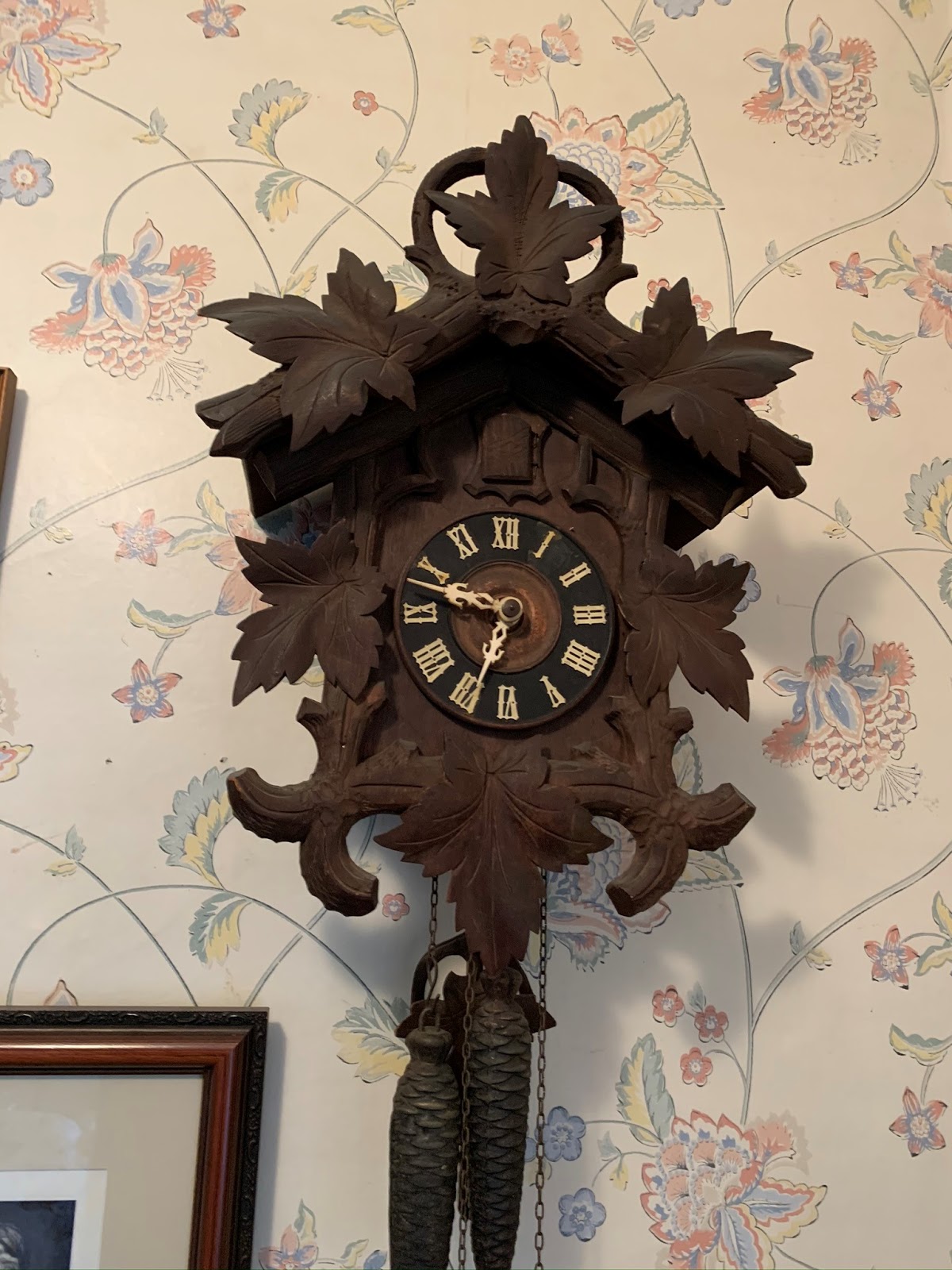
But first, from the car, I called the repair guy who has two of our antique clocks--one of which is very important to us: As I've written here before, it belonged to my great-grandfather Lanterman (Mom's maternal grandfather), then passed to Mom and Dad, then to us in 1978. And it has hung on our wall ever since--except for the (few) times it's been out for repair.

I was eager to get it back. It had stopped working a few months ago, but we were wary about going anywhere then, so we listened to the sounds of silence instead. And something seemed very wrong. I mean, we've heard its ticking, its cuckooing (hour and half-hour) for more than forty years. Joyce has called it "the heartbeat of the house"--which is perfect.


So, anyway, the clock guy said he was home and we could pick it up, so we drove about a half-hour to his place, picked up the clock (and the other one that had stopped), and headed home, stopping at a gas station to fill up our car for only the second time since February.

One of the clocks started right up and has been steady ever since. The cuckoo has not. It's run for a couple of hours a couple of times--then quit. I'll keep adjusting it as best I can until Monday, but if it's not working steadily by then, well ... back we go to the clock guy.

Damn.

Yesterday, we also did our usual after-supper run to Mickey D's--but stopped on the way at the local UPS Store to drop off an empty laser printer cartridge to be shipped back to the manufacturer (which provides free UPS returns so the company can refill and resell the empty ones).

Home then--and exhausted. We'd done so much.

And then I think about a typical day at Harmon Middle School, where I taught for decades--a place where I exerted more energy in the first-thing-in-the-morning homeroom period than I did all of yesterday--hell, than in all of this week--or month!

And I don't think I'll supply any of the words I thought of as I was comparing those two experiences--words that characterize the sort of energy I (no longer) have these days. It's frustrating--humbling--but oh so human.

Thursday, July 9, 2020

Dusty

a storm in New South Wales

When I was a kid in Oklahoma in the late 1940s and early 1950s, dust storms still rose up in the west--the sky boiling red with the region's clay soil. I remember one day in elementary school when a particularly ominous one appeared in the sky, and the principal (Miss Hinshawe!) sent us all home for the day. I was wearing my Cub Scout shirt and scarf that day (we must have been scheduled for a meeting?), and I put the scarf around my mouth and nose like a cowboy criminal and staggered home (about a mile) as the gritty red wind pounded me with pellets from the fields west of town.

Next day, in school, dust coated everything: It had sneaked through every crack in the window frames and doors.

So ... a windy introduction to what I wanted to write about today (no, not masks): dust. The other day Joyce was commenting about how we've accumulated a bit of dust during our lockdown, and her comments reminded me of a poem from years ago, from the earliest years of my teaching career (I started teaching seventh graders in the fall of 1966).

It was in a book called Reflections on a Gift of Watermelon Pickle and Other Modern Verse, edited by Stephen Dunning, Edward Lueders, and Hugh Smith and published in 1966. The year I began.

My mother had given me the book back then. For the past ten years she had been teaching English at James A. Garfield High School in Garrettsville, Ohio (three miles from our home in Hiram), and she and Dad had just accepted jobs to teach at Drake University out in Des Moines, Iowa, where their longtime friend Dr. Paul Sharp had assumed the presidency.

Anyway, Mom knew (as I, of course, didn't) that I would need some ... help ... as I commenced my career. And so before they left for the Hawkeye State, she gave me the book you see pictured below (my copy).

Until I plucked the book from the shelf this morning, I knew I had not looked at it in years--decades.  But there were some poems in there I have never forgotten--poems that I knew were in that book. And one of them (by Sydney King Russell, of whom I'd never heard) was about dust--and a woman named Agatha Morley. Here it is ...


Dust

Agatha Morley
All her life
Grumbled at dust
Like a good wife.

Dust on a table,
Dust on a chair,
Dust on a mantel
She couldn’t bear.

She forgave faults
In man and child
But a dusty shelf
Would set her wild.

She bore with sin
Without protest,
But dust thoughts preyed
Upon her rest.

Agatha Morley
Is sleeping sound
Six feet under
The mouldy ground.

Six feet under
The earth she lies
With dust at her feet
And dust in her eyes.


Dust wins, in other words--as if we didn't know!

As I paged through Reflections this morning, I noticed in the Contents that I had circled and/or marked the page numbers of poems I thought the kids would enjoy reading--or hearing. Among them were "Bones" by Walter de la Mare, "Interlude III" by Karl Shapiro, "On a Night of Snow" by Elizabeth Coatsworth, "Fortune" by Lawrence Ferlinghetti, and "Twin Lakes Hunter" by A. B. Guthrie, Jr. (he won the Pulitzer Prize for fiction in 1950 for The Way West and was nominated for an Oscar for his screenplay of Shane; I remember loving his novel The Big Sky--also a film in 1952; link to some footage; the entire film is on YouTube).


I'm remembering, too (did it happen?), that one early year of my career I had kids buy paperback copies of Reflections. And I know I used some of its poems for years.

I wish I had been better about picking the brains of my parents for teaching ideas--they both were veterans; both surely had lots of good ideas. But I was young and dumb (redundant?) and in my early 20s did not think they could really tell me much of anything that would be useful.

Stupid.

But I did accept Mom's gift of Reflections; I did use it for a number of years; I did not forget it--as Joyce's comment about dust the other day--and my quick reaction to it--certify.

Wednesday, July 8, 2020

And Gladly Teach?

In the "Prologue" to The Canterbury Tales, Chaucer, writing about the Clerk: And gladly would he learn and gladly teach.


The other day I got a message from a student who'd attended a school where I taught years ago. He now has a Ph.D. and is teaching English at the collegiate level. He said he was planning to leave and look for a teaching position in a high school ... what did I think? What advice?

Well, first of all, I did that! With a fresh Ph.D. I left public school teaching in 1978 to go teach at Lake Forest College north of Chicago (Lake Forest, IL). I thought that's what I wanted to do. I didn't, as I soon discovered, and we stayed only one year before returning to Ohio, where I would teach secondary school for the rest of my career. I did not regret that decision for a flicker of a second.

Second, I retired from public (middle) school teaching in January 1997, so my knowledge of public secondary schools today is, to say the least, dated.

Third, I retired from teaching in a prep school in June 2011, nearly a decade ago.

So ... with  those caveats in mind, read on ...

Of course, if you want to teach in a public school, you will need to have a teaching certificate from the state. That document, as you surely know, requires coursework, student teaching, etc.

Private schools, which generally pay less than public schools (and boarding schools tend to pay less than day schools), don't really care about the certification; they care about your qualifications and experience--and how much you will cost them (as I discovered when I tried to return to the classroom after my Lake Forest year).

I should add that I loved both private and public education. In both settings I had wonderful students, terrific colleagues (some of the best teachers I ever saw taught at Harmon Middle School in Aurora, where I taught most of my career). But--in my public school experience, I had more classes filled with more students. Early in my career I had 200 students/day! (That got better.) Try assigning--then grading--200 essays!

At the boarding school where I taught (Western Reserve Academy (1979-81, 2001-2005, 2007-2011) I had fewer and smaller classes (three/day with about a dozen students in each). But--boarding schools make many other demands on your time--dorms, coaching, meals, etc. It's a 24/7 job.

Public schools have changed a lot since I retired in January 1997. At that time "proficiency testing" was just emerging--and drastically altering the curriculum. (Our grandsons, 9 and 15, have taken far more standardized tests than I did, K-Ph.D.) Scores, scores, scores--those became the measure of success (or failure) for teachers, administrators, and school districts. It's horrible.

Private schools have been less affected by that foul movement. (Can you tell how I feel about it?)

But here are some realizations that I absorbed as my career proceeded: If you love your subject matter, if you remain a learner as well as a teacher, if you are comfortable with technology (which is always changing),if you are "flexible" (oh, do unexpected things happen!), if you like/love young people, if you hate being in self-dug ruts, if you have a sense of humor (and like to have fun in class), if you have a thick skin, if you are willing/eager to learn from more experienced colleagues, if you can become your own most severe critic, if you are always open to change (change needed because of your experience), well, teaching is a wonderful career. Exhausting, consuming, invigorating, disappointing, inspiring. Wonderful, in other words. The years will fly ...

Sure, I got frustrated all the time--was disappointed in myself--failed to ignite some students--got annoyed at some of the quotidian tasks of the profession--had unpleasant encounters with colleagues and parents (not often--sometimes).

But the rewards--personally, professionally (not financially!), intellectually--were enormous.

And I have to say that the vast majority of my many "friends" on Facebook are former students--and being in touch with all of them has been a heartening benefit of my career, a benefit that I never could have predicted.

So ... final advice ... Chaucer's words are key: gladly learn (never stop!) and gladly teach.