Dawn Reader

Dawn Reader
from Open Door Coffee Co.; Hudson, OH; Oct. 26, 2016

Saturday, June 13, 2020

Did I Catch Wilkie Collins Making an Error?


Did I catch a grammar error in Wilkie Collins' novel "I Say No"?

Let's back up a moment.

I learned grammar and usage the hard, old-fashioned way--having my mom and older brother correct me whenever I uttered something egregious. Mom's technique was unvarying: When I said, oh, "It was me," she would purse her lips and say something like this--as if it were part of a normal conversation--"No, I think it was I."

Soon, I felt there wasn't a lot of purpose in my saying anything, for I very often got the pursed lips and the correction.

Once I got into elementary school, though, I found I didn't need to study for usage tests. As I looked at the multiple-choice items, I would think: What would Mom say?

This worked fine--until I got into high school, into  Latin I (1958-59), and realized that although I generally knew the correct choice, I had no idea why it was the correct choice. To say the least, that ignorance retarded my progress.

Later--an English teacher--I began to learn: After all, I had to make sure the kids understood what I was teaching them. (Let's not get into how well I succeeded--or didn't.)

And I have to admit that to this very day I am still learning some intricacies of usage. (Does me a lot of good, eh?)

Okay, back to Wilkie Collins (1824-99). As some of you know, I've been reading my way, slowly, through his novels--though I began my journey with his two most famous ones (The Moonstone, The Woman in White). When I finished them, I knew I was going to have to read them all. (And I'm nearly finished.)
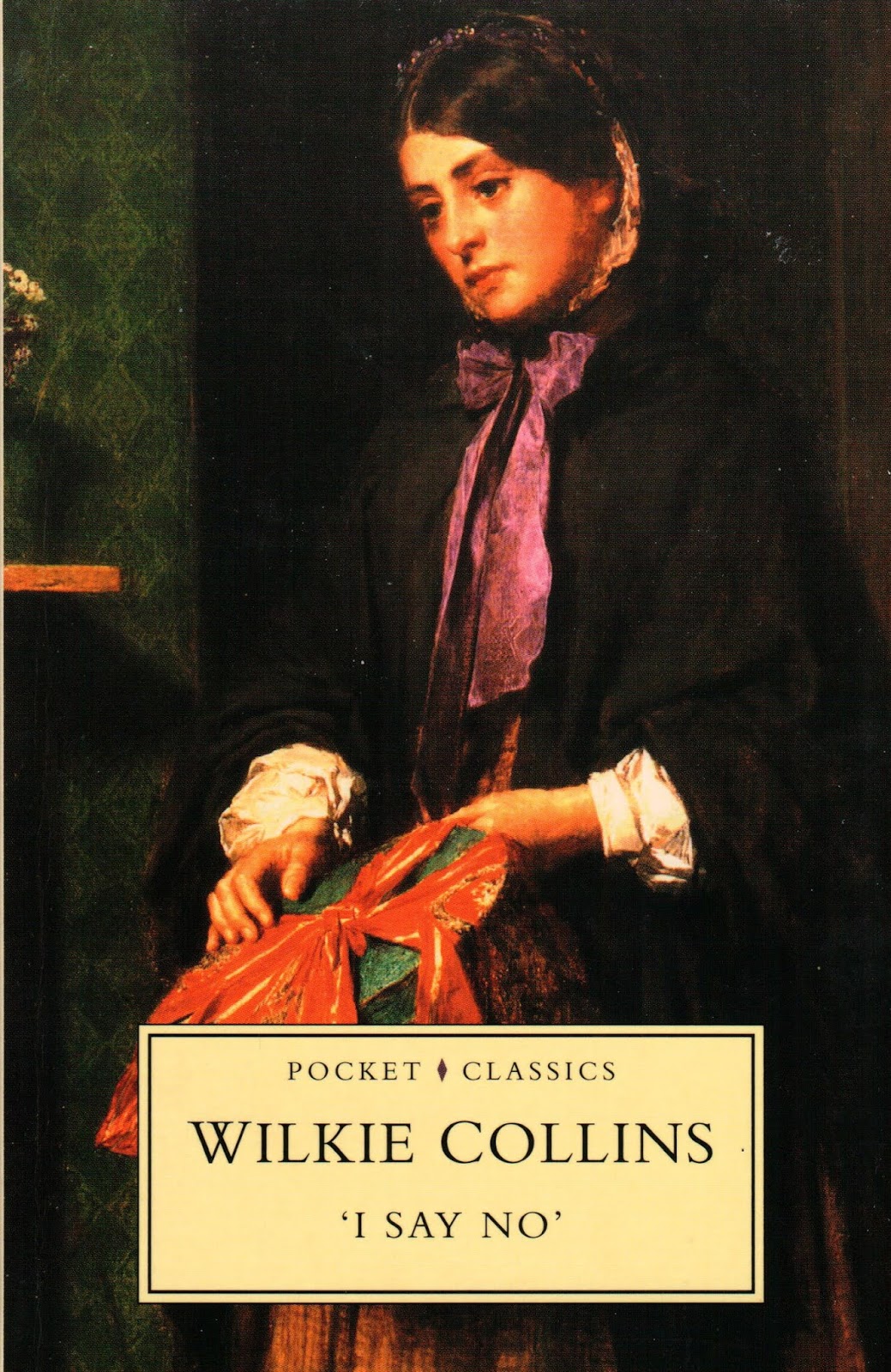


The most recent one, as I mentioned at the top, is "I Say No" (1884), and reading Chapter LI the other night, I "heard" an educated character say this: "'I'm afraid I have an idea of whom that person was'" (Pocket Classics edition, 213). I've underlined the whom to pinpoint the problem.*

I know that the word there should be who.** Did Wilkie make an error?

I was going to write a post about it, then wondered: "What if it's just a copy-edited error in the particular edition I'm reading?"

So I checked online, found some digital versions of the novel, and learned that--yes!--it was an error in transcription. My hero was still perfect!

Not that I'm a Grammar Nazi. No, I've read enough to realize that writers play with the "rules" all the time--those "rules" that, of course, we made up. Moses did not carry grammar/usage rules down the mountain with those stone tablets.

And I also know that punctuation, grammar, usage--all change, evolve.

I've published nearly 2000 book reviews over the years, and in the books I read I now frequently see alright instead of all right (a no-no in my school days); I frequently see "He's as wise as me" instead of "He's as wise as I"; I see constructions like this: "Everyone should bring their pencils." And numerous others.

So it goes.

Great writers often start sentences with and or but; they often employ comma-splices; they use the passive voice; they frequently use fragments; they end sentences with prepositions; etc. (Would you really want Grammar Nazis to have their way with, oh, Shakespeare?)

(I know: There's a difference between intentional "errors" and unintentional ones. But still ....)

We're not the same critters we were 100,000 years ago; our language and its rules are not the same either.

Frequently I need to consult the other retired English teacher in the house about an issue (and, far more rarely, vice-versa). If I'm going to break a rule, I want to know what that rule is! Then, if someone points it out, I can sneer and say, "I knew that!"

**

*The who-whom, whoever-whomever distinction is dying, I know. A lot of times I hear/read people who practice what's called hypercorrection--using something that they think sounds more "correct," but it actually isn't. Examples: between you and I, and using whom instead of who even though the latter may be the correct version.

**To decide which form, look only at the clause that the who-whom is in--ignore the words near it (like of). In this case that clause is "who/whom that person was."

Thursday, June 11, 2020

An Old Man and "Blue Velvet"


On the news (and elsewhere) these recent days I've been reading about (and seeing) the video of a police officer shoving a man who falls over backwards and hurts his head. Virtually all those reports have referred to the shoved guy as "an old man."*

He is 75. I am 75.

Hmmmmm ...

We'll get back to that in a moment.

Last night, lying in bed as a storm approached, Joyce asked me if I remembered that old popular song "Blue Velvet." I did. I sang a few lines to her as evidence (of a couple of things: my flawless memory, my still-soaring vocal talents).

Written by Bernie Wayne and Lee Morris in 1950, "Blue Velvet," for those of you who are chronologically challenged, was first released in September 1951; I would turn seven in a few months. That initial recording was by Tony Bennett. Several others recorded it, too--but the one that became a big hit was by Bobby Vinton, released in August 1963; I had just finished my freshman year at Hiram College and was not quite 19.

It was on the radio all the time (I listened to a lot of radio back then)--at all the dances--on Muzak (the stuff you heard in stores and in elevators, etc.). It swiftly rose to #1 on all the U. S. charts.

Bobby Vinton (1935- ... he's now 85!) was an example of what we used to call a "heartthrob," a "teen idol," etc.


Link to video of the song--see lyrics at the bottom of this post.

Anyway, last night Joyce told me that she'd really loved that song--but didn't really understand why because, you see, she hated wearing velvet (blue or otherwise). And she went off on a bit of a disquisition about the reasons for her discomfort, a disquisition which I, of course (a typically attentive man), raptly listened to as the thunder rolled, the lightning flashed, the trees tossed like waves (that's original, isn't it!).

Okay, back to the "old man" stuff ...

Older folks remain one of the few American cultural groups still vulnerable to comedians and filmmakers and even the press. Always okay, it seems, to make fun of the elderly. (It's pretty safe: We're fragile--what are we going to do to you?)

And it's that fragility I want to highlight in that video of the "old man." Some have said (on FB and in the White House) that his fall was fake, etc. Staged.

But here's what I saw. A simple (not really viciously aggressive) shove in the chest (Get out of our way!), some steps backward by the "old man" as he struggled to regain his balance. His fall.

(One of the disturbing aspects of that disturbing video: One cop bends to help the "old man"; another cop immediately pulls his colleague up, and on they go while the "old man" lies there, head bleeding.)

Anyway, what happened to him is exactly what would happen to me were I to receive even a light push in the chest when I am just standing on a street--only I would fall far more quickly, for my balance these days is far beyond "iffy." A lot of the time it just ain't there--at all. Hell, I fall now and then without anyone even coming near me. I am not alone, of course, which is why so many of us "old men" and "women" have canes. I'm resisting that device--too proud at the moment, I guess. I probably need a more devastating fall for Blood to inform me that It's Time.

Perhaps younger people see that video and think, "No way would that shove knock someone over." All I can say is: "Just wait."

Maybe it would help if all we unbalanced (!) "old men and women" wore thickly padded caps--perhaps made of velvet? Blue would be nice.

* I know that this incident--like most everything else these days--is deeply divisive. I'm not trying to agitate; I'm just trying to give you the perspective of another "old man," that's all.


**


She wore blue velvet
Bluer than velvet was the night
Softer than satin was the light
From the stars

She wore blue velvet
Bluer than velvet were her eyes
Warmer than May, her tender sighs
Love was ours

Ours, a love I held tightly
Feeling the rapture grow
Like a flame burning brightly
But when she left gone was the glow of

Blue velvet
But in my heart there'll always be
Precious and warm a memory through the years
And I still can see blue velvet through my tears.

She wore blue velvet
But in my heart there'll always be
Precious and warm a memory through the years
And I still can see blue velvet through my tears

Wednesday, June 10, 2020

Plastic Bottles

our family room this morning
"Venue One" (see below) is in the right corner
Some months ago (how many?), Joyce and I (as is our wont) were sitting on the couch, streaming some TV show that had a feature about plastic bottles--all this while nibbling (!) on our supper. This is how we almost always have supper, and this, I know, will perhaps disappoint some of you who think we have candlelight and dining table and family china and exotic meals every night. Perhaps I'm wearing a tux? Joyce her old prom dress?

No, we're fairly routine about most dinner things: chicken, fish, turkey slices, rice, sourdough bread, baked potatoes, spaghetti (now and then), sourdough waffles (rarely) ... all of which we make up for with Sparkling Conversation. (Believe that, too?)

Anyway, on that show (and I cannot readily find it on Google, so, perhaps, I dreamed it? I know I didn't!) the narrator told us that most plastic bottles do not get recycled, and one of the reasons? The little rings that affix the cap to the bottle--sometimes seriously so. (Husbands do come in handy now and then when some Raw Muscle is called for.)

From that day forward I have been snipping that ring off before putting the bottle in the recycle bin--sometimes with a pair of scissors and sometimes, generally at a meal, with a sharp knife (no truly deleterious consequences yet--though Joyce cringes whenever I do the latter; I try to calm her by telling her I was a Boy Scout once).

One day--a few weeks ago--I slid the knife under the ring, turned it so the sharp edge was now functional, and ... POP! The ring flew off the bottle and soared ... where? Neither Joyce nor I could find it. I thought I'd heard it hit the wall across the room. But ... no ...

So we said what we usually do in such situations. "Well, the people who buy our house will find it."

Flash forward a few weeks ...

Since COVID-19 has arrived, I've been doing my Daily Reading, morning and afternoon, not at Open Door Coffee Company but in Venue One (morning) and Venue Two (afternoon) in our house.

Venue One is in our family room, in a (fairly) comfortable chair in the far corner from the coffee table. (See pic at the top of this post.) Venue Two is in our living room, in the front of the house, where I can read, write, and stare outside at birds, trees, pedestrians, etc.

Okay. This morning I had just finished my work at Venue One (about 8:30), and I was gathering up my things to head into my study to do some work (including this blog post) when I saw a bottle-cap-sized blue ring peeking out of the lower edge of the coffee table.

There it was! (Had it thought we'd forgotten it? So it peeked out for a quick look-see--and got caught?)

I took the pic you see below, cropped it, and emailed it up to Joyce in her study.

No reply as of yet.*

BTW: Those are not crumbs you see on the ledge--an optical illusion--or a couple of smears on the camera lens ... right?


*Just before I posted this I got a reply: "!!" At times, we both can be so eloquent!

Tuesday, June 9, 2020

Back to Seidman Cancer Center

Seidman Cancer Center
Beachwood, Ohio
Monday, 9:10 a.m.

In a little over an hour, Joyce and I will drive up to Seidman Cancer Center in Beachwood, where we will have kind of a long day.

At 11:15 I'm having a couple of blood tests--metabolic panel and PSA (Prostate Specific Antigen). The PSA should be a low number (my prostate gland is long gone--surgically removed in June 2005), so a larger number indicates activity of prostate cancer (which also produces the antigen), the cancer that has remained in my body now for fifteen years, despite surgery, immunotherapy, two different periods of radiation therapy, meds, etc. The disease has now metastasized into my bones (a favorite spot for it to go in prostate cancer patients), and my oncologist has been keeping a sharp eye on that.

About noon, I'll receive an injection of nuclear material that will be followed, a couple of hours later, by a nuclear bone scan--a full-body scan that takes about forty-five minutes (seems like forty-five years). The scan is scheduled for 3 p.m.

I won't know anything for a while--I'll meet with my new oncologist next week for the first time to review the findings. (My former oncologist recently moved out of the area.) So ... we'll see what he says about all of this.

I was actually scheduled for this bone scan somewhat earlier (a couple of months ago), but I was, to be honest, afraid to go up there while COVID-19 was arriving and spreading. So ... I postponed it. At the time, today seemed like a long time off ... isn't that always the way?

Meanwhile, what do we do between the injection and the scan? We used to go find a coffee shop and sit and eat and talk and work--but that option's not available, I guess. Fortunately, it's a nice day, so we'll probably go find somewhere to be outside--at least under a tree in the car!?

Anyway, I'll update this post a little later on ...


1:15 p.m.

Well, this has been a cock-up of unpleasant proportions! We got to Seidman in plenty of time, but as I was checking in, they told me my appointments were at the Main Campus—down in University Circle!

I have never had a scan there—never gone there for blood work. So I hadn’t even looked at the lab orders and appointment location—why bother? Wouldn't it be ever the same?

No.

So ... the Seidman folks in Beachwood called ahead to the Main Campus to tell them we were running a little late (hah!), and down we drove to University Circle. Traffic was light, and we actually got there in plenty of time.

Except ...

The line waiting at the blood lab was as long as the one formed by the animals heading into Noah’s Ark. I waited an hour—which made me a half-hour late for my injection (up another floor in the building). Would they be able to work me in? But ... the phlebotomist doing the draws was wonderful--hardly felt a thing. Thanked her. Then bolted (insofar as I can "bolt" these days) for the elevators, up to the next floor, into radiology, wondering all the time ...

Will they work me in?

They worked me in.

I got my nuclear shot (in the back of my hand! ouch!) about an hour ago (I’m now feeling very very Spider-Man-y), and Joyce and I are now by the lake outside the Cleveland Art Museum, looking at the geese and goslings, enjoying the fair weather. We're also doing some reading, some writing (I'm using my trusty iPad right now). I have to be back by 2:15 to get ready for the scan.

BTW: Seeing geese and their goslings always reminds me of when our son (b. 1972) was in middle school. When he was in 6th, 7th, and 8th grade, I drove him every day to Harmon School in Aurora, where I taught, and one of our “spring adventures” each year was to look for the goslings near Aurora-Hudson Rd. Who would see them first? Always an exciting moment—which says a bit about the, uh, range of excitement in my life.


Tuesday, 8:45 a.m.

Well ... a long day yesterday. We got home about 4:30--six hours of traveling and getting shots and scans and waiting.

You have to drink a lot of water before a bone scan, so I did (my bladder urging caution, caution, caution).

I got back to Seidman from the geese about 2:15, as per instructions, and Joyce drove back to look at the geese some more. About 2:30 the technician called me in, got me onto the tray (I guess that's what you call it) that would transport me in and out of the scanner.


It's a slow process, as I said. Can't move the whole time--though the technician did pause from time to time to adjust my head (for the slkull scans), to raise my arms above my head--glad I can still do that--to get clear pictures of my chest and abdomen.

The time goes slowly, but I usually reel off (silently!) some of the many poems I've memorized over the years--helps make the time accelerate a little.

I've had quite a few of these scans over the years (a dozen or so?), so there were no surprises, just the discomfort of the procedure--and, of course, the worry about what the scans will show.

About 3:30 I called Joyce back from Goose Land; she picked me up; and off we zoomed, back home, where we arrived in time to prepare dinner--the only food I'd had all day--not counting the homemade scone I ate while goose-and-gosling watching.

I've mentioned this before re: other Seidman visits--but there is nothing more humbling--I mean nothing--than sitting in a Seidman waiting room. All of humanity is there (race, age, gender)--all in various stages of suffering. Wheelchairs, walkers, gurneys. The courage--the hope--of people is astonishing.

Also, the staff there (from noted surgeons and physicians to those checking my vitals when I entered the facility) are as diverse as humanity can be. Don't believe in the value of immigration? Walk around a cancer center facility. Take a look--a long look. And be grateful.

And, finally, how could I survive without Joyce?

I couldn't.

Now the waiting ... perhaps even more odious than the testing and scanning ...

Seidman Cancer Center
University Circle
Cleveland, Ohio

Sunday, June 7, 2020

Sunday Sundries, 280


1. HBOTW: Those grocery workers, baristas, and other people who closely deal with the public every day in these worrisome times. In my few recent encounters with them I have met nothing but Kindness.

2. I've been streaming (while waiting for Joyce to abandon her work and come join me in bed) a Netflix original called Middle School. My interest is natural: I taught in one for about thirty years.


It's about a kid--about his first day in a new school. He's got a snarky little sister, a missing dad, a loving but somewhat clueless mom, some kind of guy who helps Mom out from time to time (taking the kids to school, etc.--it's Rob Riggle, so you can imagine!).

So far (and I've not watched that much) it's about a creative, artistic kid mired in a rigorous, unimaginative school run by 2 doofuses and focused entirely on order and rules and standardized tests. I'll keep at it, I guess, though it seems, so far, not too surprising--except for the kid's drawings, which at times come alive in animation. Enjoying those moments.

Link to film trailer.

3. I finished two books this week ...

     - The first (via Kindle) was Taming the Alien, the 2nd novel in Ken Bruen's The White Trilogy (1998-2000), a trio of books featuring London cop Tom Brant, a crude, lewd, violent dude (like the rhyme?), who will do just about anything to bring down a Bad Guy. (Don't know what a hurling stick is--a hurly? Better learn.)

He's after a killer this time (no surprise), but what is a surprise is the ending. Bruen often ends his novels--the Brant series, the Jack Taylor series--with something damaging to his hero--physically or psychologically. But this time ... I actually turned the page to see if there was more There wasn't.

     - The second I finished this week was Christopher Moore's Fool (2009), one of his three novels about Pocket a diminutive, horny jester and his lumpy, large, dim apprentice named Drool. This one is based on King Lear (in which an actual fool appears, as you surely recall).


Pocket is also agile and clever and deadly with the three throwing knives he keeps concealed on his person.

This novel takes the basic idea of Lear--the old, arrogant king who offers to divide his estate among three daughters; the daughter who gets the best portion will be the one who gives the best account of how much she loves Lear. In the play--and here--much goes very wrong, when the youngest, Cordelia, says she loves him--but no more than a daughter should. Oops. Buh-bye, inheritance.

Well, like the other two Fool novels (I'm about to finish the 3rd one, The Serpent of Venice), Moore is wildly funny, raunchy, imaginative and has no reservations about plopping into his text a number of lines from other Bard plays--and even characters from those plays. (Here, we meet the three witches from Macbeth)--"Parting is such sweet sorrow" (Romeo and Juliet), "there's the rub" (Hamlet),  "the winter of our discontent" (Richard III), etc.

Oh, and we also get a reference to Green Eggs and Hamlet. And this is not at all the only anachronism. Moore is very fond of them.

Well the plot of the Bard's play goes haywire: people die here who do not die in the play (or in ways they did not die)--and Cordelia is hardly the character she is in Lear. By the end, in fact, she ... ain't tellin'.

One of the things I like about these Fool books is that Moore seems to be having the best time as he's imagining and writing them. His smile is on every page.

4. Just one more episode to stream of this season of Bosch on Amazon Prime. The TV Bosch is not a lot like Michael Connelly's LA detective in his books, but I've ... adjusted ... and am treating them as two very separate things. That way my BP rate remains low. Link to some video.


5. We're into the second season of Blood (via Acorn TV), and what a difference from season one, which focused on one daughter in the family (Cat Hogan), who, when her mother dies, is convinced it is not an accident--but a deliberate killing by ... The second season has a different focus, on another daughter, Fiona, who is having some ... issues ... of her own. The father, Jim, is played by Adrian Dunbar, a hero of the popular cop series Line of Duty--and he is here, to say the least, quite different from that upstanding police leader he plays in Line. Link to some video.


6. We're also enjoying A Confession, a limited cop series with Bilbo Baggins, uh, Martin Freeman as Det. Superintendent Stephen Fulcher--a based-on-a-true-story serial-killer investigation. So far, so good. Link to some video.


7. A bit nervous today--must go to Seidman Cancer Center tomorrow for blood tests and a nuclear bone scan. Not really looking forward to it--but I'll keep you posted.

8. Last Word--a word I liked this week from one of my various online word-of-the-day providers:

     - from dictionary.com (a word dating back only till about 1970)


shambolic [sham-bol-ik ]
adjective: chiefly British Informal: very disorganized; messy or confused: I’ve had a shambolic year, the worst ever.
ORIGIN: The word is a combination of shambles and symbolic. Shambolic is a fairly recent coinage, entering English about 1970.
USAGE:

1 “A programme to train thousands of contact-tracers to help control the spread of coronavirus has been described as shambolic and inadequate by recruits.” FRANCES PERRAUDIN, "'NO ONE HAD ANY IDEA': CONTACT TRACERS LACK KNOWLEDGE ABOUT COVID-19 JOB," THE GUARDIAN, MAY 20, 2020

2. “If democratic procedures start to seem shambolic, then democratic ideas will seem questionable as well. TIMOTHY SNYDER, "HOW A RUSSIAN FASCIST IS MEDDLING IN AMERICA'S ELECTION," NEW YORK TIMES, SEPTEMBER 20, 2016


Saturday, June 6, 2020

Out from under Our Rock


Slowly, slowly, slowly, Joyce and I are peeking out from under the rock where we've been sheltering for the past 1000 years (or so it seems)--and, yesterday and today, some actual re-emergence!

As I've written here before, the only ventures outside since all of this began involved (a) picking up our online grocery order at the Acme Fresh Market once a week (we never leave the car), (b) gathering up the newspapers from the driveway each morning (and mail deliveries on the front porch), (c) working in the yard (well, Joyce does that part).

We did go to Seidman Cancer Center a month or so ago so I could get my quarterly injection of Trelstar, the drug that has both saved (for a while) and drastically/permanently altered that life. I have to go again on Monday, too, for some other procedures--but I'll post about that later.

But this week, things have (slowly, as I said) begun to change. Earlier this week I went over to Mickey's Barber Shop to get my several months' accumulation of white hair buzzed off--my first trip there since February 13.

And last evening after supper? A trip to the gas station (where I put gas in our car for the first time since March 1--now that shows you how frequently we've been out!). And then down through the Cuyahoga Valley National Park to Szalay's Farm Market (it was their opening day) to grab some local honey and preserves, some lettuce, and (okay) a couple of peanut-butter cookies.

my back is to you--count your blessings!
All the employees were masked (as we were--we were also armed with sanitary wipes) as were virtually all the customers. Szalay's had also erected Plexiglas barriers to shield the customers from the cashiers. It was not crowded; we had no problems avoiding the unmasked.

We also stopped at the Hudson McD's on the way home for a Diet Coke--something we've not done, again, in months.

And this morning? The best of all! I walked over to my home-away-from-home, Hudson's own Open Door Coffee Company, where I got a carryout coffee (all they're doing right now), saw my "Reserved" sign still on "my" table (even though the tables are not in use as of now), chatted quickly with two of the baristas (I felt myself actually tearing up--Old Guys!). No one else was there at the time.


Walking home, I hit the ATM (I've not done that in months, either), staggered home (oh, my cursed balance issues!), chatted with Joyce, washed/sanitized my hands, heated up a homemade scone, slumped in a chair in the family room and read and ate and sipped great coffee and read and caught up on The New York Times, on email and FB, and sipped great coffee and read and read and read and read. And sipped great coffee.

Sitting there, I felt such a surge of gratitude (and relief) for all this--a surge so overwhelming that I ... use your imagination!

Thursday, June 4, 2020

Bruce Jay Friedman, 1930-2020

his books on one of our shelves--
some have disappeared over
the years
Joyce got a notice on her phone last night that writer Bruce Jay Friedman had just died. (I'd already turned mine off for the night.) I remembered his work so very well. In fact, I'd done a post about him back in 2013, remembering how much I'd loved his work, wondering why I'd quit reading him after a while. And how I was planning to read some again ... which I did (the two I mention in the 2013 post).

Anyway, I thought I'd share that post again today. And here's a link to the New York Times obituary.

Saturday, January 12, 2013


Remember Bruce Jay Friedman?


He's still alive, Bruce Jay Friedman, b. 1930.  I was reading a collection of interviews with various writers today--and there he was.  I'd pretty much forgotten all about him.  Yet, there was a time when I read everything he wrote.  Novels, plays, stories, essays.  He wrote movies, too, and his short story "A Change of Plan" has twice been filmed as The Heartbreak Kid.  He wrote the screenplays for Splash and Stir Crazy and Doctor Detroit.  He was/is very, very funny.

I just went to the F section on my shelf (not on my transcript) to see what Friedman lingers.  And there I found his novels Stern (his first, 1962), The Dick (about a detective--keep your naughty thoughts to yourself, 1970), About Harry Towns (1974).  In this last, I've done some pencil-underlining and annotating, which I'll have to erase if/when I sell it.  I've underlined this, early in the book:

... he loved tiny, intricately made gadgets; he had a vision of filling up a warm, comfortable apartment with them, living in it, and spending most of his time turning them on and off.  You couldn't do that to people, but you could do it to gadgets. And they didn't go wrong, the way people did.  If a gadget malfunctioned, you threw it away and got another one (14).

I also have a copy of his play Scuba Duba (1967), but I don't see a copy of Steambath (1970), which I read several times, mostly because it made me laugh so hard I had to struggle to retain bodily fluids.  It portrays God as a Puerto Rican steambath attendant who manipulates life and fate from a  TV screen (as I recall).  Yes, Friedman was funny--irreverent.  I loved his work.

And then ... I stopped reading it.  And he sort of vanished from the cultural radar, too.  I would guess most younger readers have never heard of him.  I have no memory of my reason(s) for my abandonment of him.  I probably just moved on to other heroes.  So it goes.

In the interview I read, Friedman remained funny--"It's a miracle anybody my age is sitting here," he says.  He talks a bit about writing, saying he does not begin a short story until he knows the final line--and jokes that he begins each day trying to figure out how to "put off writing as long as possible."

But the line that got me was this one: "I'm really impressed by how little I know."  This from a man in his eighties, a man who has spent his life reading and writing.  But it's the kind of thing I hear writers and readers say all the time.  I've found that people who study the most are often the people who will most readily admit how ignorant they are.

During the time when I was researching and writing biographies of Jack London, Mary Shelley, Edgar Poe, and Shakespeare (forget his first name), I was astonished how each source I found would send me off to a dozen or more others that I didn't even know existed.  And each of those would propel me in myriads of other directions.  It's virtually never ending.  And all a biographer or historian or memoirist can do at some point is just stop; continuing means madness.

It takes a bracing mixture of humility and self-confidence to admit how little you know.  It's a mixture that's especially rare in our public discourse--when's the last time you saw a Talking Head on TV admit he/she didn't know something?  They're all so ... positive they are right.  Bullheaded is the fancy word for it.  Arrogant is another.  Frightened is another.  (What will people think if I admit I'm uncertain?  Or that I've been wrong?)

 I learned many things from Friedman, back in the day.  It's time to learn some more.  I just checked on Amazon and discovered he has a recent memoir (Lucky Bruce) and a collection of stories and a novella (Three Balconies).  Learning that made me feel ignorant all over again.  And happily so.

So I ordered them.

pic of Friedman in 1967
from Times today