Dawn Reader

Dawn Reader
from Open Door Coffee Co.; Hudson, OH; Oct. 26, 2016

Wednesday, April 15, 2020

Stop All the Clocks

W. H. Auden, 1907-73

I stole the title of this post from W. H. Auden (whose poetry I've come to love more and more as I've grown ... older). It's from his poem "Funeral Blues,"* and here's the part I stole: "Stop all the clocks, cut off the telephone ...." Link to entire poem.

Although most of that poem has nothing to do with this post, this particular line does. Let me explain ...

In our house we have three antique clocks--i.e., they have to be wound regularly (or, as in the case of our cuckoo clock, have chains pulled). The oldest and most precious is the cuckoo clock that belonged to my great-grandfather Warren A. Lanterman, who lived on a farm in Austintown, Ohio, for more than 90 years. When he died on March 30, 1963, that clock moved to my parents' wall in Hiram, Ohio, then traveled with them out to Des Moines, Iowa, in 1966 when they continued their teaching careers at Drake University.


When they retired and moved to Oregon in the late 1970s, it became ours and has hung on our wall ever since--in Kent, Ohio; in Lake Forest, Illinois; in Hudson, Ohio (three different places); in Aurora, Ohio.

We've had to have it repaired a few times, but it's generally been a steady, ticking companion for more than forty years.

Until this week.  It stopped. Usually this means it's gotten a little out of alignment on the wall, needs to be adjusted until the ticking is strong and clear and regular.

Not this time.

The two other antique clocks we bought in Lake Forest, Illinois, during our year's sojourn there (1978-79) when both of us were teaching at Lake Forest College, and I was discovering I didn't want to be a college professor. (A discovery I made very soon, BTW.)

Both are mantel clocks. One is a more traditional shape, the other more upright.
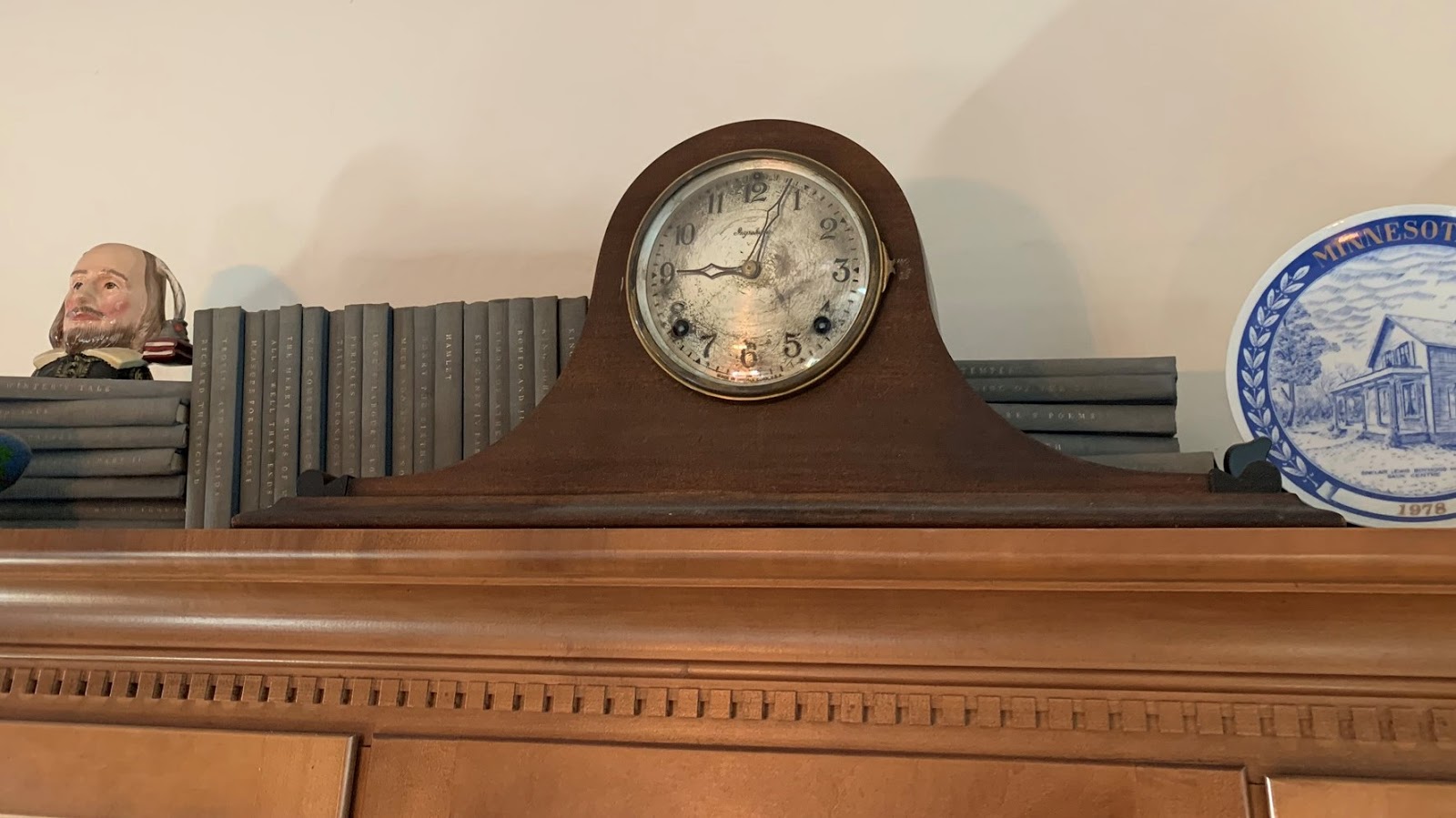

the quitter

The latter quit this week.

Again, I tried adjusting its position (usually works--didn't this time).

The single remaining functional wind-up clock is still ticking away, but throughout much of the house there is a silence I don't like. (Joyce doesn't like it, either.)

For more than forty years, you see, the ticking of those clocks has been the heartbeat of our house.

And it's also hard not to see ... symbolism! ... in all this. (Two English teachers in the same house? Of course we're going to see symbols everywhere!)

Lots of people, you see, have been posting a similar message on Facebook: Under the virus lock-down they're losing track of time. They don't know what day it is, etc.

So maybe our clocks, fed up with the disrespect on the Internet, have shut down and will--magically--begin ticking again once the lock-down lifts.

If they don't, though, I have a good "clock guy" to call.

But, oh, do I miss those steady sounds, day and night and night and day and night ...


*I've posted this before ... but I became aware of this poem when I saw the film Four Weddings and a Funeral in 1994. Loved the poem. Memorized it. And here's a link I've posted other times, showing the scene in the film when one of the characters, Matthew (played by John Hannah), recites it at the funeral of his lover. Very moving.

Link to the scene.

Tuesday, April 14, 2020

A May Surprise

senior picture, 1962, Hiram High School
The last week or so, people on Facebook have been posting pictures of themselves as high school seniors--in a way it's supposed to be a sort of tribute to those current seniors who are not getting to enjoy the final weeks of their high school careers--or to have the sort of end-of-it-all celebrations that so many of the rest of us were fortunate to have.

I joined in the other day, posting the picture you see at the top of this post. I got some ... comments and questions--like why was I leaning? (I don't know--probably the photographer told me to--or I had something heavy in my blazer pocket.) Some were probably wondering where my teeth were. (I was self-conscious.)

A couple noticed the National Honor Society pin on my blazer--and I was wearing it, I'm sure, because I wanted people to be impressed. (Shows what a doofus I was.)

Last night, as we were about to turn off the lights, Joyce asked me about that pin--and I remembered the story.

It was May 11, 1961 (my junior year), and I was sitting in the classroom of Augustus H. Brunelle, who, that year, was teaching me both German I and English III.

He was the Real Thing, Mr. Brunelle. He'd been unable to finish his Ph.D. dissertation because of World War I but had taught at Hiram College before moving to the high school. A devoted teacher, a scholar--a great man. (It took me too many years to realize this. He passed away in 1978, when, more than ironically, I was an English teacher in Aurora--11 miles away from Hiram--and was on strike.)

Anyway, that 1961 day I was sitting in his classroom--which lay in the basement of the old Hiram High--and I was looking out an upper window into the parking lot. (So unlike me to be distracted!) And then I saw something completely surprising: my mom's car driving in.

Her car was unmistakable--a blue Ford Anglia, maybe the only one in Portage County at the time.


Was I in trouble? Or maybe something was going on with Dave, my younger brother in seventh grade?

Mom was a high school English teacher in nearby Garrettsville (3 miles away), and seeing her "out" in the late morning of a school day was very unusual, to say the least.

When the class ended, we all headed to the gym for the induction of new National Honor Society members. I had no thought that I would be among them. I was a decent student then (not great) and cared more about sports and school plays and girls than about anything else. NHS was for the scholars in our class, I assumed--and we had some great ones.

So I sat in the bleachers, glad that I was out of class, glad that lunch was so close, still wondering what Mom was doing there ...?

The assembly continued, and I heard them call my name.

You could not have surprised me more if you had told me that the Celtics had just drafted me. Or there was a call from Hollywood waiting for me in the Office.

In a daze I walked down to the chairs where the inductees were sitting. I have to say, I felt out of place, an alien, a wee terrier among wolves.

I think we each got a rose that day. That felt odd to me ...

But it was also one of the few times when I had a glimmer that maybe, you know--maybe--I had something more in me than being a mediocre athlete, a passable actor, a none-too-reliable boyfriend.

And I realized something else: This is why Mom is here!

It was.

I wish I could remember a single thing she said to me after that assembly, but I was so swollen with self-importance that my ears were blocked.

It took some more years for me to realize what an amazing mom I had. I wish I'd known then. I wish I'd been keeping a journal and had written down every syllable she uttered to me that morning.

I wish she were here right now, to tell me ...

the very pin I was wearing in that 1962 photo


Monday, April 13, 2020

Cracked ... Again!


I just cracked my ceramic scone pan--again. It wasn't too bad--a chip off the old block--so I went ahead and baked the batch I'd just mixed up (apricot-walnut). And then I headed to my computer and ordered another one from King Arthur Flour (the 2nd one this year)--oh, that I had Merlin on call just to fix the damn things I've been breaking lately!

I feel innocent, really--all I did was gently (?) bump the pan against a harder surface, and I heard a chip fly from the fluted edge of the pan and land in the sink (the only good news: I didn't have to crawl around on the floor looking for it).

Let's pause a moment and talk about apricots ...

I love them--always have. Though, in early boyhood ...

Right after WW II we were living in Norman, Oklahoma, where my dad was working on his doctorate at the University of Oklahoma--thank you, G. I. Bill! And, by the way, this commenced my father's life-long passion for the Sooners football team. He grieved whenver they lost, which wasn't too often back then (they once won 47 games in a row--still an NCAA record, I think). He passed that passion along to his three sons; it stuck with two of them, the two younger ones.

Anyway, Norman ... We were living next door to a family who had an apricot tree. I was not yet old enough for school (and my little brother had not yet arrived to steal my position on the Family Fondness Chart), so I roamed around the yard--and one day, seeing apricots on the tree nearby, decided I would climb a few limbs, eat a few (free) apricots.


As you can see from this pic (which I, uh, just borrowed form Google), the trees are not high--easy for a four-year old--especially a dumb, hungry one--to climb and sample

Which is what I did.

I felt they were a little .... tough? What I didn't realize then was that they were not yet ripe. Very green. And that, as I was to discover later to my mother's chagrin (and, okay, disgust), had some gastrointestinal consequences that we will not discuss.

But that experience did not dim my fondness. (Little boys can be forgiving.)

And I have loved apricots ever since.

BTW: We pronounced the word APP-rih-kot; others say APE-rih-kott. Which is it?  Just checked, Dictionary.com says it's either way. (Whew.)

Back to this morning's event ...

I've noticed, during this shutdown period in our lives, that I have become increasingly clumsy. Dropping things. Breaking things. Chipping things. Watching helplessly as things I've dropped roll under the bed--or the dishwasher--or the fridge--or down the floor vent---or to some mysterious place where I cannot find them at all.

I find myself at such times muttering curses at myself--never loud enough for Joyce (or the neighbors, who, by the way, do not have an apricot tree) to hear. But sufficiently loud enough for my soul to hear them, and shudder in agreement.

Sunday, April 12, 2020

Sunday Sundries, 272


1. HBOTW [Human Being of the Week]: The young man at our local Acme (grocery store) who brings our online order out to our car each week with kindness, cheer, and alacrity! One of the unsung souls in this crisis ...

2. I finished one book this week, Deacon King Kong (2020), the latest novel by the gifted James McBride, who won the National Book Award for Fiction for his previous novel, The Good Lord Bird (2013), a novel about Hudson's own John Brown. McBride came to the Hudson Library and Historical Society on March 4, 2014--along with his jazz group! Played some music, did some reading aloud, talked with the audience. Pic shows Joyce with McBride--getting a book signed, talking about John Brown.

Anyway, Deacon King Kong ...  This is a rich story from 1969 in South Brooklyn and features a wide, even dazzling, array of characters. The "deacon" is the church title of a man everyone in the neighborhood knows as Sportcoat. A drunk with a kind heart. He has lost his wife and has never truly recovered (at times, though, he has conversations with her).

Sportcoat used to be the local baseball coach (and umpire in other games) and had a great reputation for both. One of his greatest stars, Deems, now 19, a kid with Major League talent, has abandoned baseball for drug-selling and has hardened as a result.

The novel begins when Sportcoat, drunk, walks up to him and shoots him.

And away we go. Before all is over we have hitmen, the Mob, some hilarious attempts by shooters to get Sportcoat, cops, characters from the local church (young and old and very old), and secrets, and on and on. With Love, Love, Love, as well.

It is a novel about redemption and hope, fear and change, and is deeply spiritual, as well.

I won't give away anymore of it. I'll just say that one of the main characters here is Surprise--often, we find out that things that happened have not happened in the way we thought they did.


3. Joyce and I are still trying to walk a mile every day--though we skipped a couple of the cold, unpleasant days this week.

4. I've been reviewing books for Kirkus Reviews since March 1999. And this week--something new. Because of the virus (and costs) I'll no longer be reviewing  what they call arc's (advance reading copies--pre-publication paperbacks that are not the final version of the text--but close). Instead, I'm now getting .pdf files of the text. I started reading the first one yesterday on my iPad, and, actually, I kind of like it. The principal reason? My eyesight has become more iffy in my latter days, and with the .pdf I can enlarge the text. It's also easier to hold and deal with. So, we'll see how it goes ...

5.Have you streamed Blood, a series on Acorn TV?


It features the main character from Line of Duty (Adrian Dunbar, who plays the police Superintendent)--but here he's playing a very different kind of man. ('Nuff said.) We're enjoying it, though when it gets too tense, I wimp out and go to a Netflix comedy. (In the pic below, Dunbar is the one in the foreground.)


6. We're enjoying the Netflix stand-up special by Ronny Chieng (whom some of you know from his role as a correspondent on The Daily Show). Some funny bits. (Link to some video.)

7. A sigh of relief this week when a King Arthur Flour order arrived (after a several-week delay). I use their bread flour to feed my sourdough starter each week (it produces a great texture), and I was running low--enough for maybe one more batch. Now I'm set for a couple of months!

8. Final Word--a word I liked this week from one of my online word-of-the-day providers.

     - from wordsmith.org

nimrodize (NIM-ruh-dyz)
verb intr.: To behave like a tyrant.
ETYMOLOGY: Nimrod was a great-grandson of Noah’s, according to the Bible. He was a hunter and an evil tyrannical king. Earliest documented use: 1614.
USAGE:
“And for a crowne who would not Nimrodize.”
Christopher Brooke; The Complete Poems of Christopher Brooke; 1872.


Saturday, April 11, 2020

Much Ado About Something


Last night we had tickets to see Much Ado About Nothing, a production of the Great Lakes Theater Festival at Cleveland's Hanna Theater. But the Festival has canceled all its productions until the fall. I was really looking forward to this one because I used to teach that play to my 8th graders at Harmon School the last few years (1994-97) of my public-school teaching career. And I loved doing so.

I had started teaching a Shakespeare play in my 8th grade classes during the 1985-86 school year, and up until 1994 (Kenneth Branagh's fine film of Much Ado had come out the year before), I used The Taming of the Shrew—snd showed my classes Franco Zeffirelli's 1967 film of the play, the one starring Richard Burton and Elizabeth Taylor. (Link to some video.)

I had fun with that play, too--the war between the sexes. Not, uh, irrelevant in middle school! And in that play the Bard employs a lot of devices he uses in other comedies: cross-dressing, deception, foolish servants, and the old people-are-not-always-who-they-appear-to-be theme.

Later, by the way, I got to see a couple of my former Harmon students--our son, Steve, and Andy Paul—play key roles in a production of the play at Western Reserve Academy. Andy played Petruchio; Steve, Lucentio. The two lover-boys!

Anyway, once I saw the Branagh film, I knew I had to shift to Much Ado. Branagh and his then-wife, Emma Thompson, played Benedick and Beatrice, and in the cast were John Wick (uh, Keanu Reeves), Robert Sean Leonard, Kate Beckinsale, Denzel Washington, and Michael Keaton--mostly performers that all the kids had seen before, except Beckinsale, who would go on to her own notable career).


Also, the themes were powerful--and relevant. Betrayal and lies, gender roles, forgiveness.

Re: forgiveness. At the end of the play when Hero forgives Claudio for his grotesque behavior at what was supposed to be their wedding (he's been misled--has thought she betrayed him; he publicly shames her at the broken wedding), I remember one day a young woman in my class cried out, as we were reading that scene aloud, "Why did she forgive him!"

And a great conversation ensued.

By those later years of mine, I'd adopted the technique of reading the play aloud with the kids in class. That way I could clarify things that were difficult, could ignore things that weren't really all that relevant, and answer questions as we went along. (I used this technique later with Hamlet at Western Reserve Academy.)

I'd also spent some weeks, prior to our reading, introducing the kids to Elizabethan England and its ways, to Shakespeare's life (about which we don't know a whole lot), to the conspiracy theories about who really wrote the plays (he did). 

I showed them a gazillion slides I'd taken in England--London, Stratford-upon-Avon. We listened to Elizabethan music, learned and played Elizabethan games, etc. I had a ball.

One of my final years, having taught the kids about thee, thou, thy, thine, I required them to use those words in our class. That was fun, too!

Then ... retirement in January 1997.

By then, Joyce and I were season-ticket holders at Great Lakes (I'd several times supervised field trips down there to see productions--including Romeo and Juliet). We'd see, oh, four or five shows each season, had very good seats (close to an exit!), and just had a wonderful time.

Earlier this year, we couldn't go see their production of Sleuth, so we'd given our tickets to our son and daughter-in-law, and they had a grand time, too.

Anyway, now that my health does not allow us to spend a week each summer at the Stratford Festival up in Canada (we saw eleven plays in six days for about 15 years!), the GLTF was our principal contact with the theater world. And now ... this season's canceled.

We donated our tickets back to the company (declined a refund). We want them to continue.

We want to go there again. And again. And again. And ...


Friday, April 10, 2020

Spring Has Sprung

This morning.
There was a kind of a nursery rhyme I vaguely remember from boyhood: 

Spring has sprung.
Fall has fell.
Summer’s here—
So what the hell?

That’s the way I remember it. But all over the Internet are all kinds of versions, a common one being this:

Spring has sprung.
Fall has fell.
Winter’s here.
It’s cold as hell.

Which makes more sense, I guess, than the lines I remember. (I was at an age when knowing something that had the words damn or hell in it was surpassingly naughty—i.e., delightful.)

Anyway, those lines occurred to me this morning when I awoke to find snow scattered about in our yard—and on our car (see pic above).

Two days ago, it was in the upper 60s, and the sidewalks were full of people in summer clothes. (I should hasten to add: All of them were social-distancing.)

In a northeastern Ohio spring, as residents know all too well, we get all seasons recapitulated, sometimes in a single day.

Yesterday, for example, it was not too cold—and then it was—it rained—it snowed—the sun came out—then went away—it was windy—it wasn’t. About the only thing we didn’t have was colorful leaves. Though maybe we could count the pink and yellow blossoms buffeted about by the stiff wind that had cruelly stripped them from their stems?

Right now, as I sit here looking out a window of our living room, I see people walk by in winter attire: heavy coats, wool stocking hats, gloves. Some are walking short-haired dogs that look annoyed. Their grim faces seem to say to their owners: You can choose to be back in a warm place, and you wanted to come out here?!? You, with your winter gear, and I with only a half-inch of hair!

Though Joyce and I have gone walking most mid-afternoons since the shut-down, we will eschew that activity this afternoon. I’ve become a wimp, you see? When I was in my jogging days, I used to go out even in the severest cold and run 4-6 miles. Virtuous I.

But today? I think I’ll sit here and type.

Thursday, April 9, 2020

Waste


Waste not, want not--a saying that seems to have originated in the late eighteenth century. It's a saying whose impact most of us, I would think, are truly understanding these viral-lockdown days.

Let's go back to my youth a moment...

When I was a kid, it was routine for drivers to toss out their windows the refuse they'd accumulated: waste from a stop at a drive-in restaurant, a tissue you'd just used to blow your nose, a finished cigarette or cigar. I still remember my dad's knocking the ashes from his pipe out onto the highway.

Then came the late 60s and 70s and Earth Day, the years of environmental awareness, and a series of TV commercials about not littering, including the famous one I'll link to in a moment, one that shows tears on the face of a Native American. (Link to commercial.)

And people--well, most of them--stopped using the side of the road as a garbage dump. Of course, any observant person today can see that not everyone has stopped the practice.

My parents, in other ways, were not wasteful, not at all. They had come through the Great Depression, through the rationing of World War II (I still have some ration coupons my mother never redeemed. I was going to scan them to show you, but ... can't find them right at the moment.) Image below is from Google.


My mother, I'm sure, learned most of this from her parents. When Mom's mother died in May 1978, I was on strike--Aurora City Schools. But I flew out to Columbia, Missouri, where my grandparents had retired, and helped Mom do some of the cleaning of their place. The refrigerator and freezer were jammed with leftovers.

Later, as my mother was nearing the end of her own life, my brothers and I would keep her occupied in the living room; then one of us would go clean out the refrigerator/freezer, which generally contained enough leftovers (many of which had, uh, changed colors) to supply her during, oh, a virus lockdown. Once when I was doing the cleaning, I could hear her call, Danny, what are you doing?

Uh, nothing, Mom. (A lie I'd perfected in adolescence.)

Joyce and I have been pretty frugal throughout our marriage. Especially in our early years (we were married late in 1969). We had very little money, so we routinely saved and ate leftovers. As our financial situation improved somewhat, we became a bit more wasteful--not horribly, shamefully so. But more so than we are right now, that's for sure! And more so than we ought to have been.

Now, we try not to waste a damn thing. We freeze-and-eat-later. We make ugly stews of leftovers. And early this morning, for example, down in the kitchen, I found that our roll of paper towels was about done--all that was left was that tight little piece that clings to the roll and defies you to remove it without destroying it. I often don't bother.

This morning, I bothered.

I gently, gently, gently removed the final piece--intact--and laid it aside to use later today. Then put on a new roll.

And the clouds then opened, and I saw the smiling faces of my mother and grandmother.