Dawn Reader

Dawn Reader
from Open Door Coffee Co.; Hudson, OH; Oct. 26, 2016

Thursday, April 6, 2017

Candy Dan


Last night, talking with Joyce, I found an allusion slipping from between my teeth. A candy allusion. Red Hots. (I warn you: Keep clean thoughts in your head!)

I can't remember the exact context--at my age I'm fortunate to remember the following morning what I'd talked about the night before! But ... Red Hots escaped a moment from my memory, where it had lain dormant for decades, and fled through my teeth.

They were not my favorite candy back in boyhood, but back in boyhood I didn't quibble much about what brand of candy was available. Someone say "candy"? Into my mouth it went. I would not, in a word, buy Red Hots, but I would consume those purchased by a friend or family member. Just being polite, you understand.

I did have several favorites back in the late 1940s and early 1950s when my boyhood metabolism--a fiery furnace to rival the one that once accommodated Shadrach, Meshach, and Abednego (appropriately, their story appears in Daniel 3--link to KJV of the story)--could consume, convert to energy, everything that went in my face.

Not no more.

Anyway, my other boyhood favorites (in no particular order):

  • 3 Musketeers (back then, the bars had two little lines in the chocolate indicating how you could easily divide it into thirds, and the ads on TV showed gracious little boys and girls doing just that--sharing with friends; this never happened with my friends and me)
  • Oh Henry! (years later, I learned that the name of the bars had nothing to do with the famous writer of short stories; when I was teaching O. Henry one year, I actually got in touch with Corporate and asked them about the name; apparently it involved, years ago, an office boy named Henry, a young man people always yelled to when there was Work to Be Done)
  • Baby Ruth (apparently named for the infant daughter of Grover Cleveland, not for the baseball great)
  • Snickers.
  • Tootsie Roll (not a great favorite--but in a pinch ...)
  • M&M
  • orange slices (the candy kind)
I didn't care that much for Milky Way--but, as I said earlier, anything would do--especially if I hadn't paid for it.

And here's something to make you sigh (and understand how old I am): All the major candy bars cost five cents each. (They were a bit smaller--but not that much.)

As the years rolled on, I narrowed down to Snickers and M&M (peanut), and Joyce, by the way, consumed piles of Reese's Peanut Butter Cups, though she and I, at the movies, would "share" the M&M's; this "sharing" sometimes occasioned some ... disagreements (mild, mild) about who was eating more than his (!) share of them.

And then ... older ... my weight beginning to annoy me (and after years of yo-yo weight gain and loss), I began to eschew rather than chew candy. Haven't bought any for years. Our movie trips are now most definitely not Candy Land--a game, by the way, that our tiny son somehow managed almost always to win.

I took it well. I was a mature adult. A father.


Okay, a confession to end with: When our son was very little, we would store all his Halloween candy in a drawer, telling him it would not be healthful to, you know, eat it all at once. We would dole it out over the ensuing days. Except for the Snickers. Which I had, you know, eaten all at once. (It took some years before he noticed this perfidy. It's possible he's forgiven me by now.) Did he notice that Peanut Butter Cups had disappeared, as well?


Wednesday, April 5, 2017

Frankenstein Sundae, 299


• In volume three of her series, there is a touching moment when Mary quotes her own father, William Godwin, about Cervantes (1547–1616), the subject of this entry. The greatest men have looked upon Don Quixote as the best book that was ever written. Godwin said, “At twenty I thought Don Quixote laughable—at forty I thought it clever—now, nearly sixty, I look upon it as the most admirable book in the whole world.”[1]
• Throughout her volumes and entries, Mary is particularly sensitive to death—of the principal whose life she is rehearsing, of relevant loved ones. And knowing how death has been such an unwelcome guest in her own life, I read these entries with a bit of emotion from time to time; it’s surprising, I know, to report that while reading encyclopedia entries from the mid-1830s I found myself occasionally … red-eyed.
In her first volume about French writers, she paused in her biography of Rochefoucauld (1613–1680) to write this paragraph about death: These are the stings, this the poison, of death.  There is no recal [sic] for a hasty word; no excuse, no pardon, for forgetfulness, for injustice or neglect;—the grave that has closed over the living form, and blocked up the future, causes the past to be indelible; and, as human weakness for ever errs, here it finds the punishment of its errors.  While we love, let us ever remember that the loved one may die,—that we ourselves may die.  Let all be true and open, let all be faithful and single-hearted, or the poison-harvest reaped after death may infect with pain and agony one’s life of memory.[2]
If you know anything about the life of Mary Wollstonecraft Godwin Shelley, you know that as her hand wrote these words, she was thinking of her lost children, her lost husband and friends. And she knew that her father was aging, and, in fact, he would live only a year after this volume appeared.


[1] Lives of the Most Eminent Literary and Scientific Men of Italy, Spain, Portugal, vol. 3 (London: Longman Rees, Orme, Brown, Green & Longman; John Taylor, 1837), 182.
[2] Eminent Literary and Scientific Men of France, vol. 1 (London: Longman, Orme, Brown, Green, & Longmans; John Taylor, 1838), 91.

Tuesday, April 4, 2017

Brave Blossoms

see them trying in the gray light

Outside our bedroom window (upstairs) and outside my study window (downstairs) we can see some brave magnolia buds that are broadening into blossom. You'd think they'd been in northeastern Ohio long enough to know that these early appearances are not all that wise. (Snow is in our Friday forecast!) But there they are. The spring light has told them (fooling them?) that it's time to emerge, so they have, even though ill winds are stirring, even though Death can't wait for them to appear so that he can make them wither and disappear for another year. Old story: those who create, those who destroy.

We humans are quite adept at seeing in blooming trees our own emerging hopes--just as we look, in the fall, at the changing/falling leaves and get some intimations of mortality. Sometimes it's stunning to me to think that any of us can ever say "Next month ..." or "Next year" ... or even "Tomorrow." Human arrogance. We seem to be the only animals that know they are going to die, but we spend lots of energy in pretending it won't happen, We even have the audacity of a future tense.

I certainly spent much of my life thinking that only other people died. The old, weak, careless, deserving (!?!), etc. Of course, there were deaths close to me that stunned me--that made me begin to modify this naive (and even cruel) belief. My Osborn grandparents. My uncle Ronald Osborn, his wife (Naomi), his daughter (Virginia--killed in an auto accident at 18). My father-in-law, my mother-in-law--who were so supremely kind to me. My father. November 30, 1999. Yesterday. Five minutes ago.

In the last two months alone two of my dearest friends have died--Dorothy Munson Steele, whom I knew (and loved) from Hiram College days and Mike Lenzo, who, early in my career (I was 23!), became the building principal at the Aurora Middle School where I was about to start my third year of teaching seventh graders. Mike changed my life and remained a dear friend until Death decided to kill the bloom once again.

My mother is hanging on at 97, but I am expecting a phone call any day. Death has been toying with her--as he did with my father. And--I swear!--when he knocks on my door, before he has even a chance to say, "It's your turn," I am going to punch his rotten face so hard that he will get a slight understanding of what he's been doing to the rest of us.

And now--at 72--I know perfectly well my time is coming. I mean, I've known it for a long time, but now ... I know it. There's a difference.

I realize it's part of the cycle of things here in our sublunary world. Nothing remarkable about it whatsoever.

Except, of course, this time it is I.

And that, as the poet said (sort of), makes all the difference.


Monday, April 3, 2017

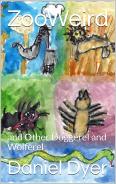
ZooWeird--a doggerel collection, soon available


A few moments ago, I uploaded to KindleDirect my latest collection of doggerel 'n' such. This one comprises about 100 "poems" about weird animals, a series that ran on my Daily Doggerel blog from December 1, 2016-February 28, 2017.

Below is the Foreword to the volume, which will appear on Amazon.com in a few hours.

Foreword

I’m not sure where I got the idea of this collection. It just “arrived,” I guess, as did the topics for the other collections I’ve written and uploaded to Kindle Direct. I’m not sure whether to be happy or sad about it. It just is, you know? One day a thought is there; months later a collection of silly verse has arrived. An unexpected pregnancy and birth.
I do know this: Once I decided to accept this idea-from-who-knows-where—this idea about writing poems about weird animals—I knew I needed to find a list of strange creatures. And fast. Having such a help close at  hand would save me lots of time Googling—and would save me from being like the lost motorist who staggers around a vast parking lot searching for his car that he left he-can’t-remember-where.
And in my list hunt, I was amazingly fortunate to find this site— http://www.strangeanimals.info/p/z-animal-list.html—which provided not only a varied and fascinating list but all sorts of other information, including photographs and video. As you read through these “poems,” I urge you to visit the site and see pictures, learn lots more about the critters I temporarily captured in these lines.
The pieces originally appeared in my blog—Daily Doggerel (http://dailydoggerels.blogspot.com/)—where I try to keep up a routine of daily postings (usually succeed—not always); each day I also posted the blog link on Facebook for my “friends” to ignore. (I’ll be kinder: Quite a few people actually read them—and some even commented! But, for the sake of space, we’ll not get into the positive-to-negative ratio.)
So … there are about ninety “weird-animal” poems here (a three-months’ supply). As is the case in my previous books of this ilk (see my author page on Amazon.com), I also have included a section called “Desultory Doggerel,” occasional pieces about my quotidian pursuits and observations. These pieces also originally appeared on Facebook.
The third section is called “Wolferel,” a term I coined a few volumes  ago, a term that applies to lines that I think are a bit ahead of “doggerel” on the road to PoetryLand but are not quite there yet. As I’ve said before, the Gatekeepers at PoetryLand are a fussy lot—not to be disrespected, disdained, bored, or otherwise annoyed. Maybe one or two of my offerings will tempt a border guard or somehow slip unnoticed through the gates (or perhaps the breakthrough might occur during a shift change? a nap? a moment of inattention?), but I’ll not know until I find that the authorities have discovered the lines—illegal aliens!—and deported them.
Or not.

April 3, 2017


Sunday, April 2, 2017

Sunday Sundries, 137


1. AOTW: Can't really identify anyone in particular ... oh, well, there's one guy, but I'll not mention him and what he does to ANNOY. Let's just say ... he can ANNOY me in ways that few others have managed to accomplish in my life.

2. Our older grandson, Logan (just turned 12), broke his leg out in California while he and the family were there on spring vacation. Surfing. He's now in Arizona for a bit (with his other grandparents) and will be home in the next few days, we're all hoping--as soon as he's able to travel. There are few feelings worse than those caused by an injury to a child you love.

3. I finished three books this week.

     - I've been slowly reading--via Kindle--the novels (in order of publication) by Craig Johnson, all featuring Walt Longmire, a contemporary Wyoming sheriff. Longmire is also a Netflix series now, and although I like the guy who plays Longmire (Robert Taylor--no, not that Robert Taylor from Ivanhoe days!), the stories don't really resemble the novels too much. So I'm in that odd position of liking both the series and the books, treating them as separate entities.

Anyway, the one I finished this week--As the Crow Flies (2012)--involves an opening horror: a mother and her small child go off a cliff. Why? Who? Etc.? Touchy scene at the end when Longmire and another are trapped in a basement with gas leaking--danger of explosion, bad guy with fire--etc. Fun to read these books.

     - I also finished a new book, Ice Ghosts (2017), by Paul Watson. It's the story of several voyages of discovery. The first--those nineteenth-century attempts by the Brits (and others) to find the Northwest Passage. The book focuses on one of those most spectacular--and mysterious--attempts, the Franklin Expedition (1845-46), led by Sir John Franklin, a journey that cost everyone his life and that has remained, in some ways, a mystery ever since. What happened to his ships? There were two--Erebus and Terror--and both were just gone.

Not no more they ain't.

Canadian teams found both in the past few years (Watson was there for one of them). Exciting story--with lots of history and geography and the kind of quotidian detail that can bring people and their era to life. And a strong portrayal of Lady Franklin, who would not give up, who prodded reluctant (male) authorities to do something, the sorts of (male) authorities who thought women belonged back at home ... you know.

We saw//heard Watson at the Hudson Library last week. He had a PowerPoint and talked lucidly and smoothly, sans notes, about the expeditions, the discoveries, the science involved (remember science?), and the reasons the ships were lost for so long. One reason: The white explorers did not believe the tales of the local Inuit, who, you know, were primitive. What could they know? Quite a bit, it turns out.

     - I also finished Julian Barnes' The Sense of an Ending (2011), a short novel about an older man who realizes that memory is fallible (and self-protective). I like Barnes but had not read this one but decided to do so when, a couple of weeks ago, Joyce and I saw the recent film (2017) based on the book, a flim starring the great Jim Broadbent (I first noticed him in Iris, 2001, a film about novelist Iris Murdoch and her losing battle with dementia; Broadbent was dazzling as her husband) and featuring Charlotte Rampling, whose work I've enjoyed since I first saw her (I think) in Farewell My Lovely back in 1975! (Link to trailer for film.)

In The Guardian yesterday, there was a long piece about how Barnes told the filmmakers, basically, to do just what they wanted with the book--and they did. (Link to Guardian piece.) There are quite a few differences--from minor to major (in the book, for example, the narrator/protagonist does not own a camera store; book dialogue is sometimes in the mouth of a different character; Broadbent does not "stalk" Rampling to find out where she lives; and on and on). But the flow remains the same--the guilt for grievances committed, the regret, the tactful forgetting of the ills we've done.

I love this--which begins Part Two of the book: Later on in life, you expect a bit of rest, don't you? You think you deserve it. I did, anyway. But then you begin to understand that the reward of merit is not life's business (65).

I did find the novel a little ... repetitive. Numerous observations about memory and time--that sort of thing. But I really liked both the film and the book: Both found ways to slice open the human heart to reveal that regret and dismay live there, as well.

4. I got a note from Netflix this week: Season 19 of Midsomer Murders is available to stream. He's got a new junior detective with him, too (see image). I don't know why I feel so compelled to watch all of these--I don't really think they're very good. But it's one of those habits--like snack food, like cigarettes, etc.--and I just can't shake it, though I've been sorely tempted--though not so sorely tempted as Joyce, who groans when she hears the theme music. So should I. Instead, I watch on and on and on and on and ...


5. Final words: words I enjoyed this week from my various online word-of-the-day services.

     - from the Oxford English Dictionary--a word with two quite different (and amusingly different) meanings.

bracketology, n.
Origin: Formed within English, by compounding. Etymons: bracket n., -ology comb. form.
Etymology: < bracket n. + -ology comb. form.

 1. The action or practice of augmenting a manuscript text with passages known or thought to be missing, enclosed in brackets. nonce-use.

1983   J. M. Duban Anc. & Mod. Images Sappho 2   The translator of Greek lyric poetry, when not dutifully bracketing lacunae (‘bracketology’)..can as readily be found converting fancy to context.
 2. U.S. The activity of predicting the participating teams in a tournament (typically the NCAA basketball tournament) and the winners of the competition's stages, as depicted in a diagram representing the sequence of matches. Also as a count noun: a set of such predictions.

1997   Plain Dealer (Cleveland, Ohio) 10 Mar. 1c,   Every student of bracketology knows the NCAA Selection Committee's seeding process can lead to some success in picking winners, but it's the daring choice of a surprise first- or second-round winner that earns the respect of one's co-workers.
2000   Montgomery (Alabama) Advertiser 12 Mar. e6/1   Over-the-edge fans study Advanced Bracketology to prepare for today's events.
2007   Wisconsin State Jrnl. 28 Dec. d4/4   A lot of things can happen, so I try not to get too caught up in the bracketologies.

2012   D. P. Gallagher & J. Costal Self-aware Leader x. 147   ESPN adopted Joe's bracketology system and marketed it to millions of sports fans.

     - from wordsmith.org (I like the metaphorical meanings possible for this one)

ecdysis (EK-duh-sis)
noun: The shedding of an outer layer: molting.
ETYMOLOGY:
From Greek ekdysis, from ekdyein (to take off), from ek- (out, off) + dyein (to put on). A related word is ecdysiast. Earliest documented use: 1867.

USAGE:
“George Osborne became a junior Opposition Whip in 2003, a Shadow Treasury spokesman the following year, and in 2005 Shadow Chancellor -- multiple ecdysis possible only in times of political defeat.”
Quentin Letts; The Next Prime Minister?; Daily Mail (London, UK); Jul 9, 2015.


Saturday, April 1, 2017

An ugly expression ... meaning changed ...


Lately, I've been reading the Michael Chabon books I'd not read previously. A few weeks ago, I read his first novel (The Mysteries of Pittsburgh, 1988), and right now I'm working my way through A Model World and Other Stories (1991). Fun to read a writer in his youth--seeing those flares of talent, that facility with words that emerges so rarely (and so mysteriously) and seems to be present in good writers from the very beginning.

Yesterday, reading the first story in the collection--"A Angel"--a tale about a young man at a wedding who sees a woman he doesn't know, finds her attractive, asks who she is, hears that he ought to avoid her ("She's a big mess"--25), goes to her anyway, talks, concludes: "She was a basket case" (26).

I had a dim memory of the source of that expression, looked it up, was horrified. The Random House Historical Dictionary of American Slang traces the phrase to 1919--from World I--and says: a quadruple amputee. A soldier so severely wounded that a stretcher was not necessary. I can think of few expressions more disturbing, more, well, wrenching than this one.

A few decades passed, and the expression--now softened--came to mean messed up or in terrible shape--an expression applied to both people and things (cars, countries, and just about whatever you want).

Just to see what would happen, I right now typed it into Google. There are assorted explanations of the phrase. There are links to a pop song with that title. A movie--more than one actually. One (2009) is a Finnish documentary about a basketball team. The earliest (1982) IMDb identifies as a horror-comedy film and offers this little grotesque summary: A young man carrying a big basket that contains his extremely deformed Siamese-twin brother seeks vengeance on the doctors who separated them against their will. Yuck. The "comedy" in that escapes me.

But, if you think about it, unpleasant words often drift over into everyday usage and adopt a more palatable and/or metaphorical meaning. An athletic team can slaughter or murder another one.  We can get killed on our income taxes (reminder: It's April!). We can butcher an exam.

And so on.

Not all unpleasant words/phrases will make that transition, however, but I am not going to mention them. This post is already too troubling for my taste.

But I'll say this: After refreshing my memory about the source of basket case I'm pretty sure I will never again use that expression. I have no wish to have that image appear in my head, where, right now, I'm trying to lock it away where I never again will find it.

Friday, March 31, 2017

Frankenstein Sundae, 298


• She told, in her entry on Boccaccio, a story about his passion for a married woman. And then this: That the lovers suffered great misery, may serve as a warning as well as an example, of how such attachments, from their very nature, from the separations, suspicions, and violations of delicacy and ruth entailed upon them, must, under the most favourable auspices, be fruitful of solitude and wretchedness.[1] I wonder how Mary’s father reacted when he read this—from the daughter who had run away with a married man in 1814. Well, I guess we can say, at best, that from experience she had learned a few things. Solitude and wretchedness did follow—though not immediately—after her elopement, and she writes about it continually in her journal and letters.
• In her entry about Giambattista Marino (1569–1625), a Neapolitan poet, she relates a tale about his estrangement from his father, who had not been exactly thrilled about his son’s choice of profession: His father, angry at his resistance to his wishes, was doubly indignant when he gave open testimony of his new career, and actually published a volume of poetry; he turned him from his house, and refused to supply him with the necessaries of life.[2] Mary could not have written a word of that without thinking about her late husband, whose father, Sir Timothy Shelley, behaved in exactly the same manner as Marino’s.
• Occasionally in these entries Mary would wax philosophical about art, about writing, about literature, about life itself. In her entry on Vittorio Alfieri (1749–1803), an Italian poet and playwright, Mary paused to say this: Ignorance narrows the intellect, and takes the living colours from the imagination.[3] Is it too obvious to note how this resonates so jarringly in our own time?


[1] Ibid., 122.
[2] Lives of the Most Eminent Literary and Scientific Men of Italy, Spain, Portugal, vol. 2 (London: Longman Rees, Orme, Brown, Green & Longman; John Taylor, 1835), 174.
[3] Ibid., 261–62.