Dawn Reader

Dawn Reader
from Open Door Coffee Co.; Hudson, OH; Oct. 26, 2016

Monday, July 13, 2015

Frankenstein Sundae, 140


Another suicide in the Godwin-Shelley circle ...

And then, in the close Shelley-Godwin-Wollstonecraft circle there was another suicide attempt, another one, like Harriet Westbrook Shelley’s, that was sadly successful. Early in my research on Mary Shelley I learned, of course, about Mary Wollstonecraft’s first child, her daughter Fanny, named in honor of Mary’s dear friend from girlhood, Fanny Blood.
I’ve already written about the context of Fanny’s conception—her mother’s affair with American Gilbert Imlay, who, as we remember, eventually abandoned mother and daughter and vanished into the mists of history. I’ve written, too, about how when Fanny, born in May 1794, was still a little girl, she and her mother joined lives with William Godwin, who soon married Mary when she once again became pregnant, this time with the daughter she would never know, the daughter who would become Mary Wollstonecraft Godwin Shelley.
The early biographers of William Godwin and Percy Bysshe Shelley and Mary Wollstonecraft and Mary Shelley do not say much about Fanny. She was, in their view, a minor player. A character actor. A young woman who, unlike so many of the others, apparently had no literary or artistic talents. A young woman who, it seems, was physically ordinary. Nothing special. Just, you know, a human being. Oh, she had a kind heart. That sort of thing.
And I confess that throughout my years of research, I also consigned Fanny to the corners of the story. Far more interesting to me were the lives of the others—the lives of historical and literary significance. Sure, it was sad when she left home in October 1816—she was just twenty years old—and traveled nearly 200 miles west to Swansea, Wales, all of it by coach, where she executed her plan to kill herself. But, I fear, I was more interested in the reactions of the others in her life. How Bysshe dashed off to look for her, how Godwin tried to cover it all up (how embarrassing, a suicide in the family!), how Mary (19) and Claire Clairmont (18) responded.
In my elaborate trip to Europe in the spring of 1999, I made no plans to go to Swansea (which lies about 130 miles south of Porthmadog in Wales, a place I did visit and have written about). As I look at travel maps now, I see that there is no direct train connection between the two towns. It would have taken about six and a half hours to make all the connections. The bus is no better. Seven and a half hours. I suppose I could have rented a car, but I was afraid to do that—all that driving on the left stuff; I figured I’d hit someone head-on after a mile or so.
Still, as I sit and type today, I know for certain that if something “significant” had happened in Swansea, I would have figured out how to get there. I would have done it.


Sunday, July 12, 2015

Sunday Sundries, 59


1. AOTW: We're eastbound on Aurora-Hudson Rd., approaching the Stow Road intersection. Approaching us is a westbound car. I have my left signal on (we're turning north); the westbound car continues to approach, then, at the last second, sans signal, turns left right in front of us to head south on Stow--a move earning the driver this week's AOTW.

2. This week I finished the recent (2013) collection of novellas by Andre Dubus III--Dirty Love. I found myself very moved by these stories of people hanging onto the economic edge in America, a group of people Dubus understands well (before he Hit It Big he was cliff-clinging by his fingernails, too, at least to judge from his 2011 memoir, Townie). I was especially affected by the final novella (which bears the same title as the whole book), which tells the story of an octogenarian great-uncle and her grand-niece. He's a former teacher; she's a maid in a motel & clears tables at a nearby bar. He's tutoring her for her GED, but she just can't get interested. She prefers her smart-phone (which Dubus calls her "iEverything"). She gets involved online with a damaged war vet, and at the end ...? I ain't tellin'!

One of Dubus' stylistic traits--the long sentence (now and then)--or a long series of repetitions. There's a lovely one at the end of the 1st novella ("Listen Carefully As Our Options Have Changed"). A man who's estranged from his wife imagines a reconciliation. For a page-long paragraph at the end he begins many sentences with Maybe.  And it all ends with this as he's knocking on the front door of the house they once shared, the house where she now lives.

He would pay more attention, and he would let her do whatever she wanted, then and later, every day and every night and week and month she chose to stay with him, which she might not, this woman whose footsteps he now heard through the door, this woman he could hear moving through their entryway, his heart in his head once again for he did not know if he was even up for any of this, this change from change, the door swinging inward as he straightened, his wife's face lovely and surprised and waiting (80).

3. Last night, Joyce and I (via Netflix DVD) watched the Coen Bros. Inside Llewyn Davis, 2013, a film we'd somehow missed when it was in the theaters. (trailer for the film) We both love the Coen Bros. films, and this was no exception, despite its quieter, more perplexing nature. It's the story of a 1961 folksinger, trying to make it in NYC. He seems competent enough (there's lots of music in the film), but he just can't quite seem to get through the door. He's barely got a dime, is sleeping on the couches of friends and acquaintances, and there are all sorts of problems--not just with money. There's a pregnancy, an estrangement from his sister, an aging father--even a friend's cat gets caught up in his misery. Excellent cast. And--as you've got to expect from the Coen Bros.--some playfulness with chronology and perspective and the nature of "truth."


4, Some words and phrases that popped up this week

  • having a field day  I read this one somewhere this week and wondered about it, checked it out on the OED. And here's what I learned ... it dates back to the early 19th century ...
    • b. fig. A day noted for remarkable or exciting events; a period of celebration or triumph. Now chiefly in to have a field day : to enjoy a great opportunity for action or success (sometimes at the expense of others).

      1827   T. Creevey Let. 26 Mar. (1934) ii. xiii. 236   Saturday was a considerable field day in Arlington Street,..and a very merry jolly dinner and evening we had.
      1848   Thackeray Bk. Snobs xx. 74   The mean pomp and ostentation which distinguish our banquets on grand field-days.
  • nobbler was a word-of-the-day from the OED this week; it has several meanings, but the one I love is this one ...
    • A person that hits; something used for hitting. 1. Eng. regional (Staffs. and Shropshire). A person who strikes or hits; spec. one formerly employed to strike inattentive members of a church congregation with a rod. Now hist.
    •  I love the picture of a guy with a stick poking those who nod off in church. I could have used one in my classroom sometimes!
  • bespoke which comes from bespeak, a term whose 5th meaning (below) is the one Shakespeare employed in the famous scene in The Taming of the Shrew when Petruchio, who has ordered new clothes for Katherine, finds fault with all of them--including the cap he'd ordered for her.
    • To speak for; to arrange for, engage beforehand; to ‘order’ (goods).
    • Here's the moment in Shrew when the word appears ...
Enter Haberdasher

Petruchio: What news with you, sir?

Haberdasher:  Here is the cap your worship did bespeak.

Petruchio: Why, this was moulded on a porringer [a small bowl];
A velvet dish: fie, fie! 'tis lewd and filthy:
Why, 'tis a cockle [a type of clam] or a walnut-shell,
A knack, a toy, a trick, a baby's cap:
Away with it! come, let me have a bigger.

Katharina: I'll have no bigger: this doth fit the time,
And gentlewomen wear such caps as these

Petruchio: When you are gentle, you shall have one too,

And not till then.
5. Okay, why do we register a different weight on different scales?

6. I've used a Mont Blanc fountain pen for a long, long time. I love it. Imagine my surprise when I saw a full-page ad in the Times today for a new product Mont Blanc is bringing out, a scent for men! It's called "Mont Blanc Emblem." I guess they've found a use for some unused ink? And they found a model who looks remarkably like me (sans beard, of course).


Saturday, July 11, 2015

My Bathroom Photographs, 4


Continuing the sad series about the pictures on the wall of the little bathroom adjoining my study.

Okay, this one is a little embarrassing. The young George Armstrong Custer. Posing like a peacock. So what is he doing on your wall? you ask.

If you're asking that question, then you're revealing that you haven't, you know, always kept up with this blog. I've written about Custer before, now and then. And in my memoir Turning Pages: A Memoir of Books and Libraries and Loss (Kindle Direct, 2012--link to the Amazon page) I wrote a bit about my boyhood fascination with Custer--called "Autie" by his family.

That fascination began back in my Oklahoma boyhood when my parents--alarmed that I seemed interested entirely in comic books and bad TV (in my defense, it was almost all bad back in the early 1950s) and baseball--started buying for me a series of books of the kind we now call "YA" (Young Adult). They were published by Random House in a series called Landmark Books, and many were biographies of notable folks.

I see on the ever-reliable Internet that there were some 112 of them (link to list of them all), and they ranged from books about wars to books about warriors--though they tossed in a biography of P. T. Barnum and a history of American railroads, and the like. But their Main Meat was war. Civil, Revolutionary, World Wars, etc. And Custer fit right in.

My parents gave me Custer's Last Stand by Quentin Reynolds (a respected journalist, by the way) not long after it was published in 1951 (I turned seven that year), and I read it, oh, 493 times or so. Wrote book reports on it at school--that's right, reports, plural. (I was ethically challenged as a lad.) I have a copy still on my shelf, but (no longer ethically challenged) I have to report that it's not the one I originally owned. I bought in on ABE, a used-book site, where (I just looked) you can still get copies, the most expensive one listed today going for $99.99.

It's a pro-Custer book, of course--but with some surprising sensitivity about the mistreatment of Native Americans. (Surprising for 1951, that's for sure.)

As I grew into adolescence, my Custer-mania did not really diminish. On a family car trip out to Oregon (where my dad's family lived) we stopped once at the Custer Battlefield. In those days (pre-Interstate 90) it took some geeing and hawing to get there. Now, naturally, there's a freeway interchange right by the place, now called the Little Bighorn Battlefield National Monument. (Link to their site.)

And as the years went on, I read lots of other books about Custer--both nonfiction and fiction. My favorite of the latter? Thomas Berger's Little Big Man (1964--later, 1970, made into a film with Dustin Hoffman--link to YouTube trailer for the film). (And, yes, I have a first printing.)

And of course ... times changed. Custer morphed from hero/martyr to oppressor and then back a bit (some recent books credit him for saving the day for the North at Gettysburg). I continued buying and reading Custer books--even reviewed several of them (like Nathaniel Philbrick's fine 2010 volume on the Last Stand--link to my review). Joyce and I visited his home in Monroe, Michigan (there's a statue there, too), and have several times gone to his birthplace in tiny New Rumley, Ohio. For a period of years we would go down there on Labor Day with our son and have a picnic. Years later, we went there with our son and his first son on Labor Day, too. I know, I know ...

There's also a big statue of Custer in New Rumley. Here's a photo from Labor Day, 1985. Father and son (who had just turned 13).

As for the Custer photograph on my bathroom wall? I'm not sure where I got it. Perhaps in Montana at the battlefield. Maybe elsewhere. Can't remember. But it's a reminder for me of all sorts of things--of reading, of history, of changing conceptions of valor, of having a great time with my son and wife, who, loving me as they always have, indulged even the daffiest of my passions.


Friday, July 10, 2015

Meeting Jack London's Daughter, Afterword


Joan (Left) and Becky London
I met Becky London in mid-July 1990. She would live only two more years. Joan, her older sister by a year, had died back in 1971 only three days after her 70th birthday. I learned somewhere along the way that Joan, who had been an academic, had spoken at Hiram College, my alma mater,  The clipping is from the Hiram College newspaper, Feb. 14, 1929 (my mother was nine years old).


A follow-up story on Feb. 25 was headlined: London Lecture Is Entertaining. She had spoken about her father's life (he'd been dead only thirteen years). She ended the evening by reading aloud one of her father's stories (which one?), an activity, says the Hiram writer, that "rounded out an evening of keen pleasure."

Becky's death in 1992 was big news in Sonoma County, as the news clip below illustrates. And her death was the final in London's short list of immediate family.


As I wrote in the initial post in this series a few days ago, the summer of 1990 would be a very trying one for my own family. Our only child was heading off to college in the fall; Joyce's parents were failing--and fast. When we got a "long weekend" from class, I drove up to Seaside, Oregon, where my own declining parents were living in a new retirement home. When I called Joyce at home, I learned that things had gotten much worse. She needed help. So I left everything in California and flew home immediately to do what I could. Her father was dying of a fierce lung cancer; her mother's Alzheimer's had made her impossible to care for. We tried it. And failed. We eventually found a wonderful place for her--at Anna Maria in Aurora, the town where I'd been teaching since 1966.

After we got things marginally under control, I flew back to California to pick up my things and arrange for everything to be shipped home--including our car, a blue Toyota Tercel lift-back that was never the same afterwards. I had to leave the Jack London Seminar, and I was sad about that, but I knew I was needed elsewhere. And Earle Labor, my teacher, was extraordinarily helpful and cooperative.

And so we were with Joyce's beloved father as he died; weeping, we put our son on a plane to college; we helped Joyce's mother adjust to her new place; we bought a house in Aurora so that we would be closer to her. It was a wrenching time--among the most difficult of our lives. A summer of loss and grief and transition.

Thursday, July 9, 2015

Meeting Jack London's Daughter, III

the bookstore in Glen Ellen, Calif.
I've not really been stalling. Yes, it's taken me two days--two substantial posts--to arrive at my moment of meeting with Becky London, Jack London's younger daughter. But I needed to supply the context, right?

So ... here we are. In 1990 she would turn 88, and she was living in the World of Jack London Bookstore in Glen Ellen, California, near the ranch her father had once owned, near the ranch where her father died in 1916 (at the age of 40) when she was 14. Russ and Winnie Kingman, who operated the store, had offered to introduce her to me.

And so ... on July 18, 1990, I drove over to the store from Rohnert Park ... below, virtually unedited (okay, I fixed a few little problems) is the journal entry I wrote when I got back to my room after talking with Becky.

July 18, 1990
            After class today, I drove over to Glen Ellen to Russ Kingman’s store for two reasons: to give Russ a copy of the new Classics Illustrated version of The Call of the Wild (he had not seen it and was pleased); to see if I could meet Becky London.  As fortune would have it, when I arrived, she was meeting with the English biographer,[1] so I browsed around the store for about thirty minutes until she came out.  She bade farewell to the biographer (they embraced) and was about to head back in when Winnie Kingman stopped her and introduced me as someone from “Earle’s class” who would like to meet her.  (Thanks to Winnie!)
            I sort of stumbled around behind Winnie’s desk chair, reached out, and shook Becky’s fragile yet powerful hand.  She was so gracious, so friendly—without any real reason to be.  After all, she has just spent most of the afternoon talking about Jack (“Daddy” she referred to him throughout our conversation).  I told her that I’d read all of her father’s works, and she seemed so pleased, then asked me which I liked best.
            Uh oh.  Not to say the wrong thing.
            “The Star-Rover,” I opined.
            “That’s mine, too,” she said with a smile. “Along with The Valley of the Moon. You know,” she continued, “people used to ask Daddy if he believed in reincarnation, and he would just laugh and say that he knew about a lot of religions and found them all interesting.”[2]
            I said something stupid about how one of the best things about Jack’s writing was his enthusiasm for what he was himself learning; he became a great teacher through his books.  Becky agreed. “Have you read Martin Eden?”[3]
            “Sure.”
            “Well, that was Daddy. It was very autobiographical.”
            I was so—what? star-struck?—that it wasn’t until a few minutes into our conversation that I began paying attention closely to what she was saying.  She was alert, clever, and gracious the entire time.
            She appeared to be about Jack’s size (5'7" or so, perhaps a little shorter); she has his sort of square face, and the most penetrating pale blue eyes I’ve ever seen—their luster dimmed only by the fairly recent formation of cataracts. She looked startlingly like the photographs of her father, even though she has outlived him by nearly fifty years. We were so close I could smell her breath, soured a little by a long afternoon of talking about her father.
            I commented on her striking resemblance to her father, and she laughed—complimented, I hope. She said, “Except I don’t have that wavy brown hair, do I?” Then she told how she remembered going for walks with Jack and her sister, Joan, when she was just a little girl. “Daddy didn’t like city hats,” she recalled, “but he would sometimes wear one on our walks. He had a natural wave, but he would take his hand and sort of push it up a little before we went out. Before long, though, he would take off the hat. And then the wind would blow his hair all over.”
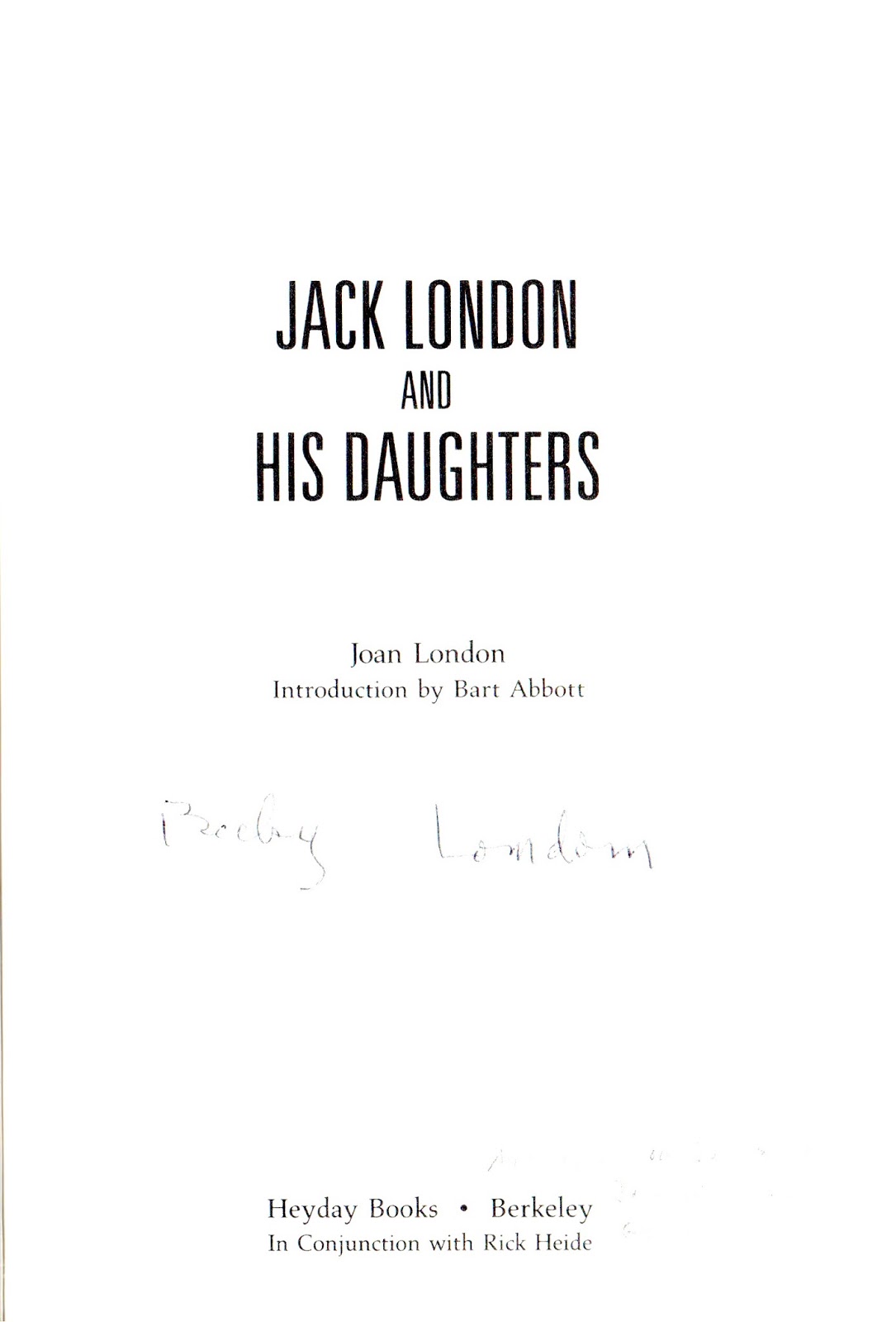
            I asked her to pose for a photograph, so she stood before some bookshelves; I trembled so much I don’t know how it came out. Then I asked her if she’d read her sister’s book, Jack London and His Daughters. She said, “No, I can’t read anymore. And I don’t know if anyone will take the time to read it to me.” I asked if she would write her name in the book for me, and, again, she graciously agreed.
            I put the blank page before her, and she asked, “Is here all right? There aren’t any words in the way, are there?” And then she signed it, without ever, I’m sure, seeing what she wrote.
            She turned to go back into the little apartment Russ had constructed for her next to his bookshop, and I thanked her, telling her what an honor it was for me to meet her.
            She turned back to me and spoke to Winnie: “Now make sure he doesn’t walk out with anything.” And laughed, those blue eyes blazing with humor and intelligence.


                [1] Probably Alex Kershaw, whose biography, Jack London: A Life, appeared in 1998.
                [2] The Star Rover, 1915, deals with the issue of “previous lives.” The Valley of the Moon, 1913, a title that refers to the Sonoma Valley, is London’s novel about the valley he loved, the valley where he built his ranch.
                [3] London’s strong autobiographical novel, 1909, which, oddly, was the first of London’s books I’d ever read. My parents had given me a copy of it (why?), and I’d read it during study halls at Hiram High School—oh, about 1960 or 1961? (Hey, beats doing homework!)

Wednesday, July 8, 2015

Meeting Jack London's Daughter, II

Sonoma State University
As I wrote yesterday ... in the summer of 1990 I drove from our home in Hudson, Ohio, to Rohnert Park, California, home of Sonoma State University, where I would spend five weeks with about a dozen other teachers from around the country who'd been selected to study Jack London with Prof. Earle Labor. It's 2477 miles, says Google Maps.

I drove 600+ miles a day, the vast majority of it on I-80 across Ohio, Indiana, Illinois, Iowa, Nebraska, Wyoming, Utah, Nevada, California, where I swung north to Rohnert Park, which is about 50 miles north of San Francisco.

In 1990 we did not yet have a cell phone (our son did!), so I called Joyce each night from my motel and heard the day's news. It usually wasn't all that good--her dad's health, her mom's struggles with Alzheimer's--but I could tell she was trying to be encouraging. Our son, Steve, by the way, had a summer job at the local McDonald's, and that experience quickly convinced him (not that he needed much convincing) that minimum wage was not--to say the least--a living wage.

I arrived at beautiful Sonoma State, got my room assignment (a single--whew), unpacked, and began preparing for my stay. Among the things I'd brought along--my Kaypro II computer and a dot-matrix printer. I was contemporary!
Our seminar routine involved a class all morning (where we talked about London, the various works we were reading); afternoons were "free"--although we had chunks of reading to do--and research for a project for the seminar. I'd settled on doing a set of annotations for The Call of the Wild, a project that, five years later, would result in the publication of a fully annotated edition published by the University of Oklahoma Press. (I told you the seminar was life-changing!) In the evenings we sometimes had various get-togethers here and there around the area. We got to meet other London scholars and folks--including Clarice Stasz (who taught at Sonoma State and has published extensively about London) and--not far away in Glen Ellen, Calif.--Russ and Winnie Kingman, who ran the World of Jack London Bookstore about a mile away from London's former ranch, which was the the Jack London Ranch State Historical Park. We made several class trips to the ranch--did some hiking--and met London's literary executor, Milo Shepard, a descendant of London's stepsister, Eliza London-Shepard. Milo owned a winery adjacent to the London ranch and was very knowledgeable about the world of Jack London.

I had been to the London bookstore a few years earlier and had corresponded with Russ Kingman (who wrote an illustrated biography of London--and, later, published a very detailed chronology of his life). He had been an Oakland businessman, had gotten involved in the development of the waterfront there--an area called Jack London Square--and had become so interested in London that he'd devoted the rest of his life to reading, collecting, and, eventually, selling. I dropped quite a few bucks in his store over the years. He and Winnie--both sadly now gone (as is their store)--were two of the kindest, most supportive people I met in LondonWorld, which had, I must say, an abundance of kind folks.

I sometimes drove over to their store in the afternoons after lunch--fifteen miles east across and through some beautiful mountain terrain (on some twisting narrow roads) with patches of redwoods that towered beyond imagination. It remains one of my favorite drives in the world--not that I've driven a lot of the world!

Tiny Glen Ellen--well aware of its Jack London heritage. 

One day--at the bookstore--Russ asked me if I'd like to meet Becky.

"Becky who?"

"Becky London."

I was stunned--I'd had no idea she was even still alive. "Where does she live?" I asked.

"Right here."

It seems she'd had an apartment in Oakland, had been robbed, had felt insecure, so Russ had invited her to live with him and Winnie--had built an apartment onto his store.

"So," he asked again, "would you like to meet her?"

I think I broke the world's record for saying, "Yes."


To be continued ...

Tuesday, July 7, 2015

Meeting Jack London's Daughter, I


While opening and looking at some computer files that I'd not seen for a long, long time, I discovered that, back in 1990, I'd written a journal entry--a fairly detailed one--about meeting Becky London, the younger daughter of writer Jack London. I'd forgotten that I'd written the account--and, as I read it, I realized I'd forgotten so much of the detail about that meeting. So ... the next couple of days, I'm going to, first, set the stage for the meeting and, second, paste into this blog the account of our meeting.

Almost exactly twenty-five years ago--in the summer of 1990--I was preparing to leave home for more than a month. I was planning to drive to Rohnert Park, California, home of Sonoma State University, where I would join some other schoolteachers who'd been selected to participate in a seminar in the works of Jack London (1876-1916), a seminar sponsored by the National Endowment for the Humanities and led by the world's principal Jack London scholar, Prof. Earle Labor, whose great biography of London--a work of a lifetime--appeared late in 2013. (Here's a link to the NPR interview of Labor in October 2013.)

I was honored to be among the teachers chosen. (We all received a stipend, too--a couple of thousand, as I recall.) In the 1982-83 school year I'd started teaching The Call of the Wild (1903) to my 8th graders at Harmon Middle School (Aurora, Ohio). I'd gotten fascinated with London and was reading my way through all fifty of his books--he wrote 50 in fifteen years. Not bad in the days before word processing! I was animated, too, by the discovery that my own great-grandfather (Addison Clark Dyer) had gone to the Klondike, just as London had in the summer of 1897.

Joyce and I (and son, Steve) had already driven out to the Sonoma Valley to see London's ranch (near Glen Ellen, Calif.), and I was excited to spend five weeks working closely with my colleagues and with Earle Labor near the very terrain that had been so important to London.

But there were problems at home--emotional ones. Our son had just graduated from high school and would be heading off to college in the fall. He was our only child, and I knew his departure was going to be wrenching for both Joyce and me (it was).

And in a darker way: Joyce's parents (who were living in Akron's Firestone Park) were having profound problems. Her mother was declining into the Alzheimer's that would eventually kill her. It was the horrible pattern--the transition from not remembering where her car keys were to, eventually, not knowing what food is, what eating is. Joyce's father had done a heroic job of taking care of her, refusing to confine her somewhere. But it was wearing him out.

And worse. That summer of 1990 he was diagnosed with the aggressive lung cancer that would kill him in mere months.

So it was with great reluctance that I packed the car and drove off into the west. I didn't make it very far--just to the first Ohio Turnpike interchange beyond where I'd entered. I'd been weeping the entire way, was overwhelmed with sorrow and guilt. How can I leave Joyce and Steve to deal with all of this?

So I got off the Turnpike, drove home, unpacked the car.

And then Joyce had a "chat" with me. She told me that she and Steve could handle it. That her father and mother would want me to go--that she wanted me to go. She told me that I would forever regret it if I didn't. And Joyce does not say things she does not mean.

So--weeping even more--I repacked and drove away again. I wept practically till Indiana.

And it would turn out that Joyce was exactly right. The seminar was a life-changing experience--to be more exact: a series of life-changing experiences.

And one of them was meeting Becky London (1902-1992).

To be continued ...